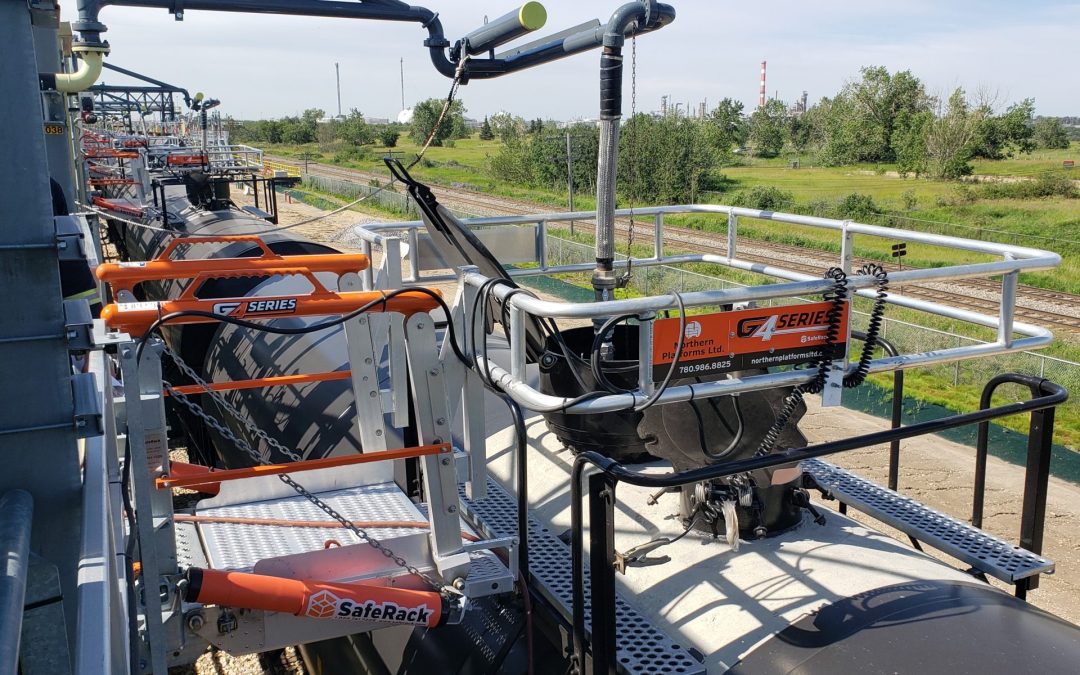
Falls from height remain one of the most serious hazards in truck and railcar loading operations, especially when fall protection equipment is not used properly. At Northern Platforms, we specialize in designing and installing systems that go above and beyond to protect workers and eliminate this risk. Keep reading to learn more about the SavkoLock Mechanica Gangway Lockdown system and how it can improve your site’s safety today.
The Problem: Unsafe Gangway Movement
Fall protection, like gangways and safety cages, is essential for all industrial sites. But here’s the truth: despite proper design and specifications, these systems can still create worker safety risks.
For example, consider this situation: In dry bulk and other multi-hatch truck operations, gangway systems often have to be moved or repositioned during loading, unloading, or inspection. In the proper procedure, the operator completes their task on top of the vehicle, walks back to the loading platform, tracks the gangway to the next hatch, lowers it to the new position, and climbs back on top of the vehicle.
Unfortunately, many operators skip these steps. Instead of returning to the platform, they attempt to lift and reposition the gangway while still standing on top of the vehicle. This unauthorized maneuver is a leading cause of accidental falls in loading bays.
The Solution: SavkoLock Mechanical Gangway Lockdown
As we’ve outlined, the above situation poses a significant falling hazard for workers. That’s why Northern Platforms and SafeRack created the SavkoLock Mechanical Gangway Lockdown system.
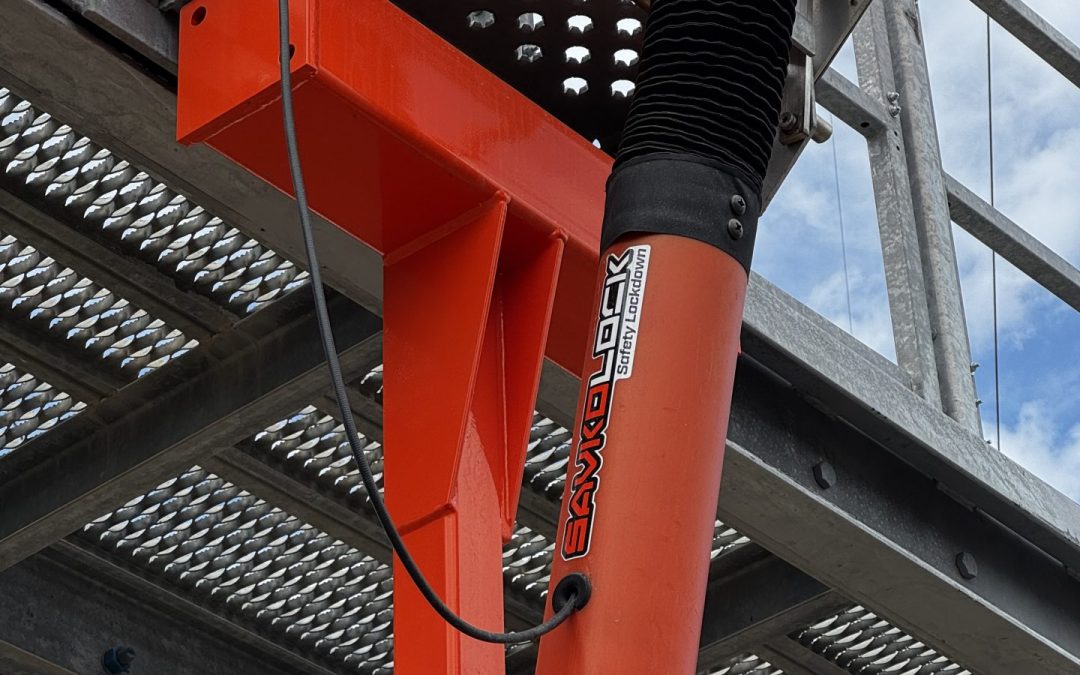
The function of this system is simple: When the gangway is lowered onto the vehicle, it automatically engages and locks the gangway in the deployed position. While locked, the gangway cannot be lifted, shifted, or adjusted from on top of the vehicle. Once the operator completes their task, they must return to the loading platform and use a foot pedal to release the lock. Since the pedal is located on the platform rather than the truck, the SavkoLock effectively discourages unsafe gangway procedures and ensures proper, comprehensive fall protection.
The SavkoLock was developed through close collaboration between SafeRack and the General Manager of Northern Platforms, Rob Sawchuk. This product demonstrates our unwavering commitment to worker safety in all situations, even the coldest Canadian temperatures.
SavkoLock Product Details
Included T-Frame support structure and mounting brackets, cabling and connections, and protective covers.
Suitable for use in ambient temperatures up to -40°C.
Assemblies available for 24”, 36”, and 48” G4 gangways.
Can be purchased with new gangway systems or retrofitted onto existing G4 gangways from SafeRack.
Easily interchangeable with the previous SafeRack SafeLok solution.
Do you have additional questions about this gangway lockdown system? Contact Northern Platforms through our website or at (780) 986-8825 for more information!
Additional Fall Protection Upgrades Available from Northern Platforms
As Western Canada’s leading experts in truck and railcar fall protection and SafeRack’s Platinum Partner of the Year for 2025, Northern Platforms helps improve the safety of industrial sites every single day. In addition to the SavkoLock, we also stock and supply a variety of other SafeRack products, including:
Safety cages: These systems attach to the front of the gangway and enclose the working area around the hatch when it is lowered. Importantly, safety cages create a guardrail barrier between the operator and the edge of the car. They come in 2-rail, 4-rail, or custom designs.
Safety swing gates: Every unsecured elevated opening on a truck or railcar loading platform poses a risk to workers. Safety swing gates are an easy-to-install solution that mounts to existing guardrail systems. Crucially, they are self-closing, which means that no opening is ever left unguarded.
We also offer preventative maintenance programs for gangways and loading arms that are conducted in strict alignment with OEM manufacturer specifications. Post-inspection, every customer receives a colour-coded report (green, yellow, red) that clearly identifies the condition of each component and prioritizes any required action.
Contact Us Today for Truck and Railcar Fall Protection
Whether you are interested in a brand-new railcar fall protection or simply retrofitting existing systems for better worker safety, Northern Platforms can help. Explore our products, request a quote, or call our office to get started!
Does your operation have the equipment it needs? If not, Northern Platforms is here to help. As a leading Western Canada supplier of SafeRack and OPW products, our team specializes in building railcar loading and unloading systems that protect workers and maintain throughput at the same time. Keep reading to learn more about the different types of railcar loading arms and platforms that we offer, broken down by application.
Common equipment considerations: Loading arm, grounding/bonding, vapour management where required, overfill protection, spill containment, gangway or access platform, fall protection, heated or jacketed components
Railcar Loading Systems for Refined Fuels (Gasoline, Diesel, Jet Fuel)
Refined fuels such as gasoline, diesel, and jet fuel require loading systems that support fast, controlled, and clean transfer. Because these products are flammable or combustible, the system must be designed to reduce ignition risk, control vapours where required, prevent spills, and keep workers safely positioned during loading. Key design considerations for refined fuel loading systems include:
Type of railcar: General service tank car for flammable or combustible liquids
Type of loading: Top or bottom loading; gasoline is commonly handled with closed loading and vapour recovery (where required)
Common equipment considerations: Loading arm, dry disconnect or tight-fill couplers, vapour recovery arm or line, grounding/bonding, overfill protection, emergency shutoff system, gangway or access platform, fall protection
Railcar Loading Systems for Natural Gas/LPG (Propane, Butane)
Liquified petroleum gas (LPG) is transported in pressurized tank cars and presents a very different risk profile than crude bitumen or refined fuels. Loading systems must maintain proper pressure during loading and unloading. Additionally, platforms and racks must meet strict industry standards (NFPA 53). Key considerations for these loading systems include:
Common equipment considerations: Pressure-rated loading arm, secure couplers, emergency shutoff valves, breakaway protection, vapour return or equalization line where required, gas detection, gangway or access platform, fall protection
Railcar Loading Systems for Ammonia (NH3)
Railcar loading systems for LPG and ammonia share several characteristics. Both products are transported under pressure, both require secure connections, and both rely on closed transfer systems to maintain containment. However, ammonia introduces an additional layer of risk: it is highly hazardous to workers if released. As a result, ammonia loading systems must be designed with particular attention to leak prevention, emergency shutoff, vapour or vent management, and safe operator access. Key design considerations for ammonia loading systems include:
Common equipment considerations: Loading arm, emergency shutoff system, secure couplers, vapour/vent management, gas detection, eyewash and safety shower access, gangway or access platform, fall protection
Railcar Loading Systems for Molten Sulphur
Molten sulphur is one of the more complex bulk liquid loading applications because the product must be kept hot enough to remain in a liquid state. If the product cools during transfer, it can begin to solidify inside the loading arm, piping, valves, or railcar connection point. Details about molten sulphur loading systems:
Type of railcar: Insulated tank car designed for molten sulphur service
Type of loading: Heated top loading through the railcar hatch
Key loading concern: Maintaining product temperature, preventing solidification, managing H₂S exposure, avoiding spills or residue, and protecting operators from burns
Common equipment considerations: Steam-jacketed or heat-traced loading arm, heated piping, vapour management or venting provisions, spill control, gangway or access platform, safety cage, fall protection, eyewash and safety shower access
Crude, LPG, refined fuels, ammonia, and molten sulphur all move by rail, but they all require different infrastructure. Each product has its own requirements for tank car fittings, loading arms, vapour control, fall protection, safety systems, and more.
As a full-service provider, Northern Platforms specializes in designing and installing complete turn-key railcar loading solutions for crude oil, refined fuels, propane, butane, ammonia, molten sulphur, and more. We have nearly 30 years of experience and have worked with some of the largest industrial operations in Western Canada.
Contact Us for a Free Quote
Ready to get started? Contact our team with your project details today.
Is your specific application missing from this list? We’d still love to hear from you. Request a quote through our website or call our office to get started on a turnkey railcar loading platform customized specifically for your operation.
Promoting safe access is the cornerstone of all industrial sites. From routine inspections to maintenance, loading, repairs, and equipment operation, workers need reliable ways to reach the areas where work actually happens.
But safe access does not look the same in every facility. Some sites need permanent platforms built around fixed equipment. Others need mobile platforms that can move between work areas. Understanding the difference between these platform types is key to choosing the right solution for your application. In this article, we’ll break down the differences between modular, mobile, and fixed industrial work platforms, including where each option is commonly used and how they support safer, more efficient work.
What Are Industrial Access Platforms?
Industrial access platforms are engineered systems that provide safe, elevated work areas for inspection, maintenance, and operations tasks. They typically combine:
A work deck or platform
Stairs or ladders for access
Guardrails, toe boards, and gates for fall protection
Generally speaking, industrial access platforms fall into three major categories: fixed, modular, and mobile. Let’s break down some key details about all these systems.
Mobile Access Platforms
Mobile access platforms are rolling or movable platforms that can easily be repositioned to where they’re needed and locked in place during use. Typically, you’ll find mobile platforms in applications where:
The work moves around the site (e.g., maintenance on multiple pumps, valves, or vehicles)
Equipment of similar height is spread across a large area
You need temporary access during shutdowns, turnarounds, or project phases
Installing a permanent structure is not practical or cost‑effective
Some examples from Northern Platforms include:
RollaStep MP Series mobile work platforms, which combine the stability of a fixed platform with the mobility of a rolling stair. Ideal for flatbed truck loading and unloading.
SafeRack MAUI Mobile Truck Loading Platform is a mobile tank truck access platform designed for safe loading access. It includes a stable base, telescoping ladder, and safety cage, with optional powered movement for easier positioning.
While mobile platforms can be useful, they should be avoided for high-traffic sites with consistent loading and unloading operations. In these situations, opt for a permanent/fixed loading rack.
Modular Access Platforms
Modular access platforms are built from standardized, pre-engineered components, like stairs, platforms, handrails, ladders, and supports, that bolt together easily. Generally, modular access platforms are ideal for:
Sites where access needs evolve over time
Projects on tight schedules that can’t wait for custom fabrication
Facilities that prefer bolt-together, no-welding installations for safety and speed
Applications where reconfiguration and expansion are expected
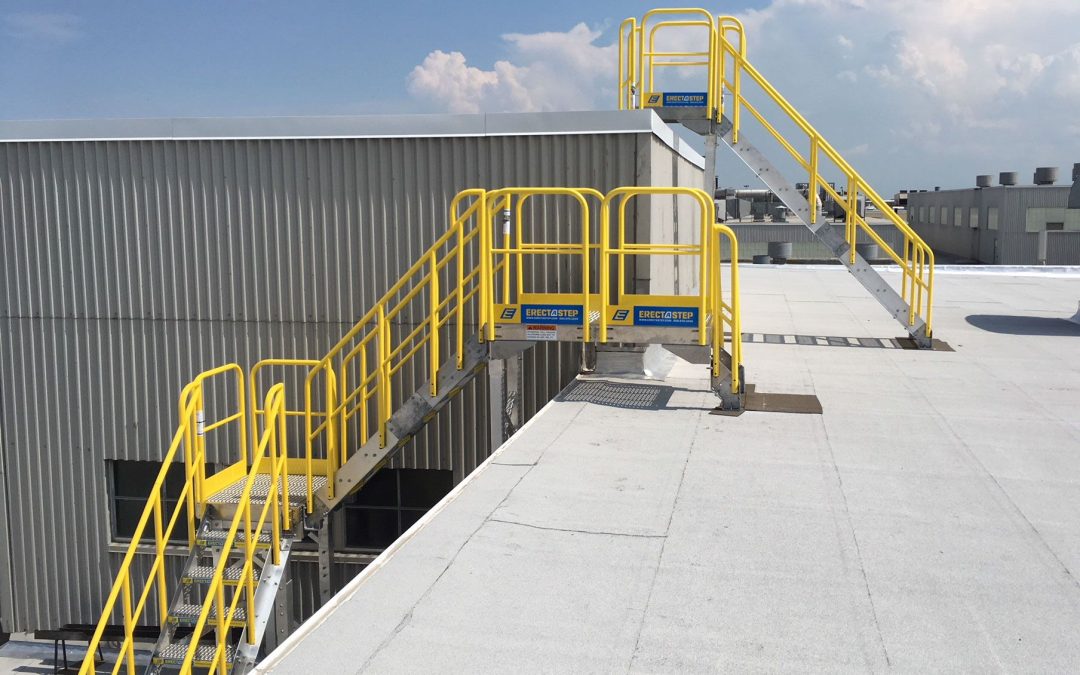
Systems like ErectaStep use a small set of standard components (universal platforms, stairs, ladders, tower supports, handrails) that can be combined into almost any configuration: crossovers, valve platforms, mezzanine access, ladder platforms, and more.
In practice, modular systems cover the majority of common industrial use cases, especially for valve access, pipeline crossovers, metering stations, industrial catwalks, rooftop access, and more. However, they are generally not used for truck and railcar loading and unloading.
Fixed Access Platforms
Fixed access platforms are permanently installed structures tied into the building, steelwork, or foundations. They don’t move and are engineered for long-term service in a defined location. Fixed platforms make sense when:
The access need is permanent and clearly defined (e.g., top of a tank, a mezzanine, or a fixed conveyor)
Loads are high or frequent, and continuous anchoring is required
Integration with existing building structure or process equipment is critical
The site must satisfy specific code or insurer requirements for permanent access
Northern Platforms has extensive experience building permanent loading platforms for a variety of applications. For further details about these projects, contact our office.
Industrial Access Platforms from Northern Platforms
Northern Platforms supplies and supports all three categories:
Mobile access platforms: Rolling work platforms and cantilever platforms for safe, mobile access to warehouse shelves, flatbed trailers, and other equipment
Modular access platforms: ErectaStep modular stairs and platforms for crossovers, valve access, metering stations, assembly lines, and more.
Fixed access platforms and loading systems: Truck and rail loading platforms integrating platforms, gangways, loading arms, and fall protection as complete systems.
Not sure what platform is best for your application? Our team specializes in assessing operations and proposing solutions that solve unique issues. For customers based in Alberta, we offer free site visits.
Railcar loading and unloading is no place for guesswork when it comes to working at height. Between changing railcar spots, varying hatch locations, and busy railyards, you need fall protection that keeps operators safe without slowing your operation down. One of the most common questions for rail sites in Western Canada is whether to invest in permanent railcar fall protection systems, rely on temporary or mobile options, or use a combination of both.
Why Railcar Fall Protection Matters
Working on top of railcars exposes operators to significant fall risks, especially during loading, unloading, venting, and inspection. Without the right access and fall protection, it’s easy for “quick checks” to turn into serious incidents.
A complete railcar fall protection strategy typically includes:
Permanent railcar fall protection systems are fixed structures designed into your facility from the start—or added later as part of a major upgrade. These can include single-spot or multi-spot loading platforms with integrated gangways, safety cages, and fall protection built directly into the rack.
Permanent systems are a strong fit when:
You load and unload from the same track locations every day
Your product mix and railcar types are relatively consistent
You want a long-term, engineered solution with minimal reconfiguration
Key advantages of permanent railcar fall protection include:
Consistency. Operators use the same access and fall protection setup each time, which supports training and safe habits.
High throughput. Multi-spot platforms can handle several railcars simultaneously, improving productivity.
Durability. Engineered structures are built for long-term use in harsh Canadian climates, with minimal day-to-day adjustment.
Integrated design. Loading arms, spill containment, and fall protection can be planned together as one system.
For high-volume, fixed-spot rail operations, a permanent platform with integrated gangways and safety cages is often the backbone of the safety plan.
Temporary and Mobile Railcar Fall Protection
On the other hand, temporary or mobile railcar fall protection solutions are designed to move with your operation. Instead of committing to a fixed structure at a single location, mobile systems can be repositioned wherever they’re needed.
These systems are ideal for:
Facilities with multiple tracks or sporadic railcar spots
Sites that see changing railcar types or leasing patterns
Operations that need safe access during shutdowns, outages, or maintenance projects
Locations where a permanent structure isn’t feasible or allowed
Rather than relying on ladders or improvised access, mobile platforms provide a purpose-built, compliant way to get operators safely to the top of the car.
Highlight: SafeRack MAUI Railcar Mobile Access Unit
Northern Platforms supplies SafeRack’s MAUI Railcar Mobile Access Unit—a portable fall protection solution designed specifically for railcar work across multiple locations on your site. This unit combines mobility, stability, and integrated fall protection in one system.
Key features include:
Self-supporting design with a 500 lb load capacity
No-flat tires for reliable movement across railyard surfaces
Double-locking winch for smooth, controlled height adjustment
4-rail safety cage that raises handrail height to 42″ around the hatch area
Slip-resistant walk surface for secure footing in all seasons
Parallel or perpendicular configurations to suit tight spots and different track layouts
Adjustable ladder heights (10′–14′ and 12′–16′ models) to fit varying railcar heights
For operations that need railcar fall protection in more than one spot or that can’t justify a permanent platform on every track, the MAUI provides a practical, compliant way to keep people safe without sacrificing efficiency.
Expert Railcar Fall Protection from Northern Platforms
Ready to explore your railcar fall protection options? The Northern Platforms team is here to help! Explore our products through our website or contact us today for more details!
Choosing the right elevated access system comes down to one key question: is your access need temporary, mobile, or permanent? Industrial facilities rely on safe, compliant access solutions, but not every worksite requires fixed infrastructure. In some cases, portable or rolling stairs provide the flexibility crews need. In others, a permanent access platform delivers greater stability and long-term value.
Wondering whether permanent or portable stairs are right for you? In this blog post we’ll discuss key features and break down the differences between these solutions. Keep reading!
What are Industrial Portable Stairs?
Industrial portable stairs are mobile access systems designed to provide safe, temporary elevation access in warehouses, construction sites, maintenance facilities, and loading areas. Depending on the configuration, they could include:
Non-slip treads
Handrails or full guardrail systems
A top platform for secure transitions
Locking casters or wheels
Heavy-duty aluminum or steel construction
Typically, portable stairs fall for industrial operations fall into two key categories.
Stairs for Temporary Buildings
Temporary modular stairs are designed to provide stable, structured access without requiring full structural installation. These systems are commonly used for:
Jobsite trailers
Temporary buildings
Elevated equipment access
Project-based application
They are typically assembled on-site and can be relocated or reconfigured as operational needs change. While not permanently anchored to the facility structure, they provide a secure, durable solution for mid- to long-term temporary access requirements.
Mobile or Rolling Stairs
Mobile rolling stairs, or portable stairs on wheels, are designed for frequent repositioning within a facility. Equipped with locking casters, these systems allow crews to move the stairs between work areas quickly and safely.
They are commonly used in:
Warehouses
Maintenance departments
Manufacturing facilities
Distribution centers
Rolling stairs prioritize flexibility and ease of movement, making them ideal when elevation points change regularly.
Interested in learning more about the rolling stair options that are currently available at the Northern Platforms? Read our complete guide or call our office for more information.
What are Permanent Access Platforms?
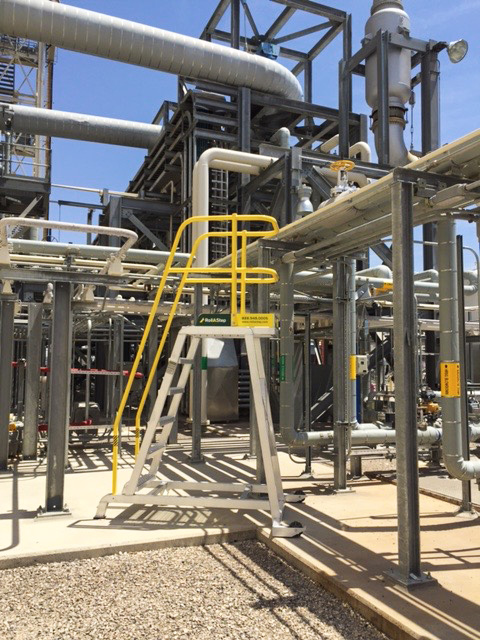
On the other hand, permanent access platforms are fixed structures installed at designated access points. While they can be modular and adaptable, the primary function of these systems is to provide consistent and reliable access to specific areas on your site. Certain options, like the modular work platforms from ErectaStep, can be custom-configured for the specific needs of your site.
How They Compare
Now that you have a clear understanding of your options, you might be wondering how these solutions compare. Use this table to understand the key differences between portable stairs and more permanent options:
Feature
Portable Stairs
Rolling Stairs
Permanent Platforms
Primary Function
Provide stable access for temporary or semi-permanent structures.
Provide flexible access that can be moved between locations
Deliver fixed, long-term access to designated elevated areas
Best For
Mid- to long-term projects requiring consistent access.
Completely customizable and modular. Available in multiple configurations.
Key Takeaway: Which Option is Right for You?
Still not sure which safe access solution is best for your site? Finding the right system is easy when you consider how it will be used within your operation.
If your access point needs to move between work areas throughout the day → Rolling portable stairs are likely the most practical choice.
If you require structured access for a jobsite trailer, temporary building, or project-based application → Temporary portable stairs provide stable, semi-permanent access without full structural installation.
If workers access the same elevated location multiple times per shift → A permanent access platform will typically offer greater stability and compliance consistency.
Make the Right Choice with Northern Platforms
No matter which option you choose, the Northern Platforms team is here to help. We work with facilities across Alberta and British Columbia to design, install, and maintain safety systems that meet real-world standards. When you partner with us, we’ll go above and beyond to understand your site, your needs, and any roadblocks.
Alberta’s energy sector depends on reliable rail operations. From oil sands loading in Fort McMurray to crude terminals near Edmonton and Calgary, hundreds of workers access tank cars daily at significant heights. Slip hazards, extreme weather, and high-exposure openings create serious risks—making professional fall protection systems essential under Alberta OHS Code Part 9. Keep reading to learn more about railcar fall protection in Alberta—and how Northern Platforms can help.
Railcar Fall Protection Regulations in Alberta
Alberta Occupational Health and Safety Code
In Alberta, fall protection requirements for worksites are determined by the Occupational Health and Safety Code, specifically Part 9. This code requires fall protection in all circumstances where workers could fall 3 meters (approximately 10 feet) or higher from an unprotected edge, platform, or opening. At railcar loading facilities, this threshold is commonly met when accessing the top of tank cars, platforms adjacent to rail spurs, or elevated gangway systems. Additionally, Alberta OHS recognizes “greater risk” situations—meaning that even falls under 3 meters may require protection if the landing surface is uneven, contains hazardous equipment, or presents other aggravating factors.
The Railway Safety Act
For facilities located on or working with federally regulated railway corridors (such as those operated by CN), additional obligations may apply. The Railway Safety Act addresses broader rail operational safety, including track maintenance, railway equipment, signal systems, grade crossings, dangerous goods handling, and the operating rules that control how workers and equipment interact with rail infrastructure. Northern Platforms designs systems that satisfy both provincial and national regulations, ensuring your facility meets all applicable requirements.
Complete Fall Protection Systems for Alberta Rail Operations
For comprehensive protection when accessing tank cars, your system will need several elements, including:
Gangways: Stable walking surfaces that connect docks and tank cars. Many Alberta operations deal with varying tank car heights, so adjustability is key. Northern Platforms product recommendation: SafeRack FRT gangway
Tank car safety gates: A simple added fall protection feature that prevents workers from falling through the crashbox opening on a tank car. Enjoy a lightweight aluminum construction, power-coated finish, and easy installation with linch pins. Northern Platforms product recommendation: Northern Platforms Rail Car Safety Gate
Additional safety systems: Beyond fall protection, railcar loading and unloading operations are required to use railcar wheel chocks and blue flags under Alberta regulations. Northern Platforms product recommendation: Aldon Railcar Wheel Chocks
Northern Platforms provides railcar fall protection to operations across Alberta, including:
Edmonton
Calgary
Red Deer
Fort McMurray
Grande Prairie
Lloydminster
Cold Lake
Bonnyville
Lethbridge
Medicine Hat
Our expertise spans oil and gas operations, petrochemical manufacturing, agricultural loading, and industrial chemicals. We understand Alberta’s regulatory environment, climate challenges, and operational demands. Ready to learn why we’re Western Canada’s number one choice for railcar fall protection systems? Get in touch with our office today.
Start Building Your Railcar Fall Protection System Today
Your Alberta railcar operations depend on fall protection designed for local conditions and regulations. So whether you are operating a Calgary transloading facility, Edmonton terminal, or Fort McMurray oil sands operation, Northern Platforms brings regional expertise and proven experience to every single contract. Plus, as a complete turnkey service provider, we can provide everything from comprehensive system design to ongoing and consistent maintenance.
Ready to ensure your Alberta rail operations meet local compliance and safety standards? Contact Northern Platforms for a no-obligation site assessment. Our Alberta specialists will evaluate your facility, recommend optimal solutions, and provide transparent proposals for supply and installation. We bring decades of experience securing workers at heights across Western Canadian energy infrastructure.
Northern Platforms is the Western Canadian leader in industrial access solutions, specializing in fall protection systems and turnkey installation services for oil and gas, petrochemical, manufacturing, and agricultural sectors. We supply some of the best products on the market, including SafeRack, ErectaStep, OPW, and more.