Flatbed fall protection depends on where workers need to perform the task.
Some jobs require workers to access the trailer deck to inspect cargo, adjust tarps, or work around the load. Other tasks can be completed from beside the trailer, but still require a stable, elevated work area to reach straps, tarp hardware, trailer-mounted equipment, or elevated cargo safely.
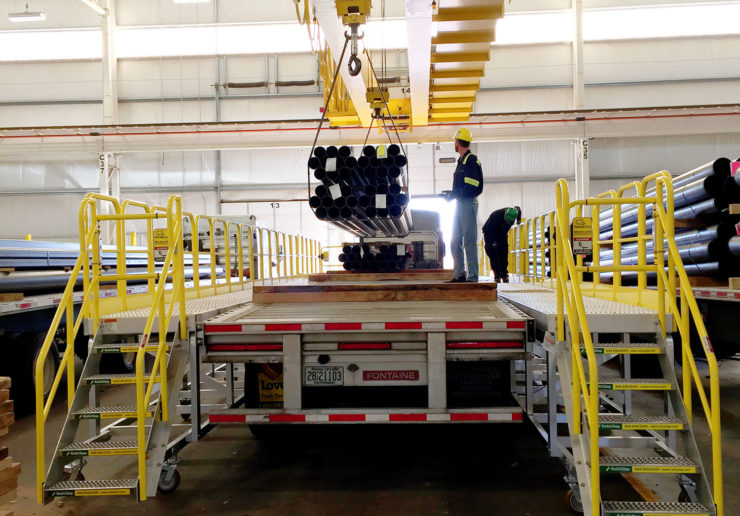
Portable guardrails and mobile work platforms can both improve flatbed safety, but they serve different purposes. Portable guardrails create a temporary protective barrier for deck-level work. Mobile work platforms provide a guarded workspace beside the trailer.
The right option depends on the task, trailer type, cargo, work location, and amount of flexibility the operation needs.
Start With Where the Worker Needs to Stand
The most important question is straightforward: does the worker need to be on the trailer deck, or can the task be completed safely from beside the trailer?
This distinction should guide the fall-protection decision.
A worker adjusting materials across the top of a load may need a different approach than someone inspecting straps along the trailer side. Likewise, a driver working on a step deck or lowboy may have different access requirements than a crew handling a standard flatbed at a fixed loading location.
Choosing equipment based only on trailer height can lead to a poor fit. A better approach is to assess the actual work, where it happens, and how the worker moves through the task.
Portable Guardrails for Deck-Level Work
Portable guardrails are removable fall-protection systems that create a defined barrier around the trailer deck or work area.
They can be useful when workers need to stand on the flatbed, move along the deck, or work around cargo. Rather than relying only on individual fall-arrest equipment, portable guardrails create a physical boundary that helps protect workers during deck-level tasks.
Portable guardrails may be appropriate when workers need to:
Complete deck-level cargo inspections
Adjust tarps or load-protection materials
Access securement points beyond the reach of a side platform
Work near the centre or far side of a load
Reposition dunnage, edge protection, or other materials
Move along the trailer during loading or unloading
Complete work at changing job sites or delivery locations
Because the system is portable, it can move with the trailer or be used at different work locations. However, it must still be compatible with the trailer, load configuration, and task. Crews also need enough time and space to set it up, inspect it, and use it correctly.
Mobile Work Platforms for Trailer-Side Access
Mobile work platforms provide a stable, guarded work area beside a flatbed trailer.
They allow workers to reach certain elevated tasks without climbing directly onto the trailer deck. The platform can be rolled into position beside the work area, then moved along the trailer as loading, inspection, or securement tasks change.
Mobile work platforms can be useful for:
Inspecting the side of a load
Checking accessible straps, chains, binders, and edge protection
Reaching tarp straps, buckles, and other hardware
Accessing trailer-side equipment
Completing maintenance or inspection work
Carrying tools or small parts to the work area
Reaching low-profile cargo from an elevated side position
RollaStep MP Series mobile work platforms can be particularly useful for flatbed applications that require more room than a conventional ladder can provide. A larger platform gives workers space to stand, handle tools, and complete the task from a guarded work area.
For safe use, the platform needs stable, level ground and enough clearance beside the trailer. It should not be placed where vehicle traffic, forklifts, uneven surfaces, or poor lighting make positioning difficult.
Compare the Work, Not Just the Equipment
Portable guardrails and mobile platforms should be selected based on how the task is completed.
If workers need to…
The better fit may be…
Work on or move across the trailer deck
Portable guardrails
Access the centre or far side of a load
Portable guardrails
Adjust cargo-protection materials on the deck
Portable guardrails
Inspect cargo or securement from beside the trailer
Mobile work platforms
Access tarp hardware, trailer-side equipment, or side-mounted securement points
Mobile work platforms
Move the access solution along the trailer as the task changes
Mobile work platforms
Complete elevated side work with tools or inspection equipment
Mobile work platforms
The distinction is not always absolute. A mobile platform may help workers reach the trailer side before they use a portable guardrail system for deck-level work. In some operations, both systems may be useful at different points in the same workflow.
Trailer and Cargo Variation Matter
Trailer type and cargo profile can affect whether portable guardrails or mobile work platforms are practical.
A standard flatbed, step deck, lowboy, or trailer with side kits may all have different deck heights and access needs. The same is true for cargo. Pipe, lumber, fabricated steel, machinery, crated materials, and oversized loads can change where workers need to stand and what they need to reach.
Before selecting a system, consider:
Trailer length, deck height, and configuration
Cargo height, width, and location
Position of straps, chains, binders, and tarp hardware
Whether workers need access to the deck, load centre, or trailer side
Available clearance around the trailer
Surface and weather conditions where the work occurs
Whether the equipment needs to travel with the trailer or remain at one facility
A solution that works well for one trailer-and-load combination may not be the right fit for every job.
Choose Northern Platforms for Flatbed Fall Protection
The best flatbed fall-protection solution is the one that allows workers to complete the task without relying on unsafe climbing, inconsistent ladder use, or improvised workarounds.
Need help choosing flatbed fall protection that fits your operation? Contact Northern Platforms to discuss mobile work platforms, portable guardrail options, and practical access solutions.
Falls from height remain one of the most serious hazards in truck and railcar loading operations, especially when fall protection equipment is not used properly. At Northern Platforms, we specialize in designing and installing systems that go above and beyond to protect workers and eliminate this risk. Keep reading to learn more about the SavkoLock Mechanica Gangway Lockdown system and how it can improve your site’s safety today.
The Problem: Unsafe Gangway Movement
Fall protection, like gangways and safety cages, is essential for all industrial sites. But here’s the truth: despite proper design and specifications, these systems can still create worker safety risks.
For example, consider this situation: In dry bulk and other multi-hatch truck operations, gangway systems often have to be moved or repositioned during loading, unloading, or inspection. In the proper procedure, the operator completes their task on top of the vehicle, walks back to the loading platform, tracks the gangway to the next hatch, lowers it to the new position, and climbs back on top of the vehicle.
Unfortunately, many operators skip these steps. Instead of returning to the platform, they attempt to lift and reposition the gangway while still standing on top of the vehicle. This unauthorized maneuver is a leading cause of accidental falls in loading bays.
The Solution: SavkoLock Mechanical Gangway Lockdown
As we’ve outlined, the above situation poses a significant falling hazard for workers. That’s why Northern Platforms and SafeRack created the SavkoLock Mechanical Gangway Lockdown system.
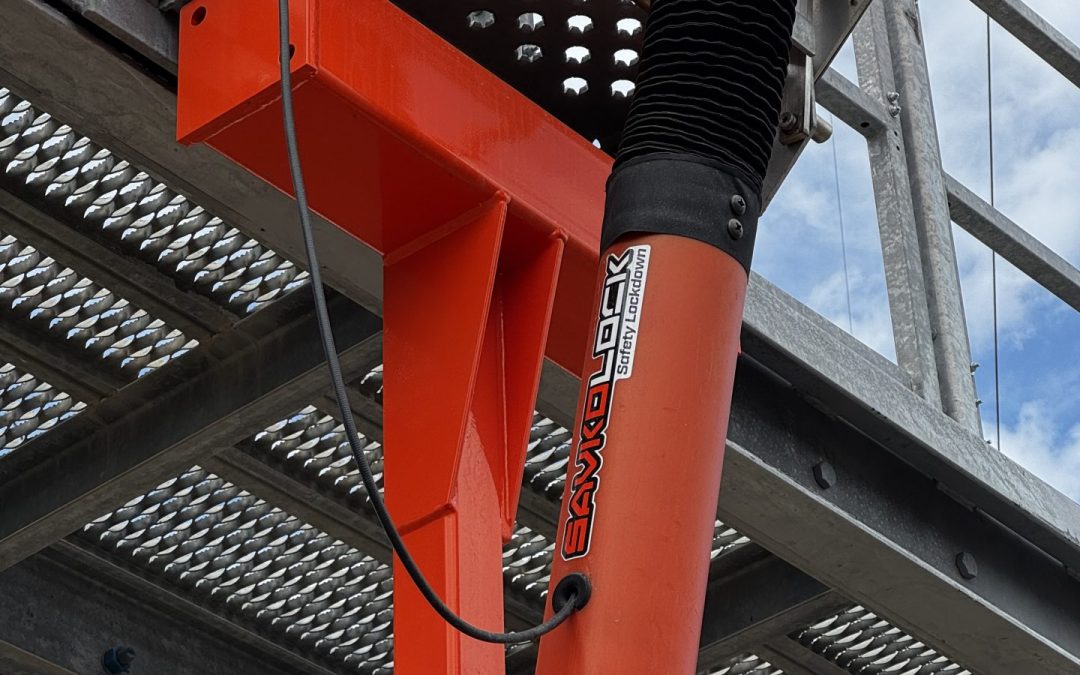
The function of this system is simple: When the gangway is lowered onto the vehicle, it automatically engages and locks the gangway in the deployed position. While locked, the gangway cannot be lifted, shifted, or adjusted from on top of the vehicle. Once the operator completes their task, they must return to the loading platform and use a foot pedal to release the lock. Since the pedal is located on the platform rather than the truck, the SavkoLock effectively discourages unsafe gangway procedures and ensures proper, comprehensive fall protection.
The SavkoLock was developed through close collaboration between SafeRack and the General Manager of Northern Platforms, Rob Sawchuk. This product demonstrates our unwavering commitment to worker safety in all situations, even the coldest Canadian temperatures.
SavkoLock Product Details
Included T-Frame support structure and mounting brackets, cabling and connections, and protective covers.
Suitable for use in ambient temperatures up to -40°C.
Assemblies available for 24”, 36”, and 48” G4 gangways.
Can be purchased with new gangway systems or retrofitted onto existing G4 gangways from SafeRack.
Easily interchangeable with the previous SafeRack SafeLok solution.
Do you have additional questions about this gangway lockdown system? Contact Northern Platforms through our website or at (780) 986-8825 for more information!
Additional Fall Protection Upgrades Available from Northern Platforms
As Western Canada’s leading experts in truck and railcar fall protection and SafeRack’s Platinum Partner of the Year for 2025, Northern Platforms helps improve the safety of industrial sites every single day. In addition to the SavkoLock, we also stock and supply a variety of other SafeRack products, including:
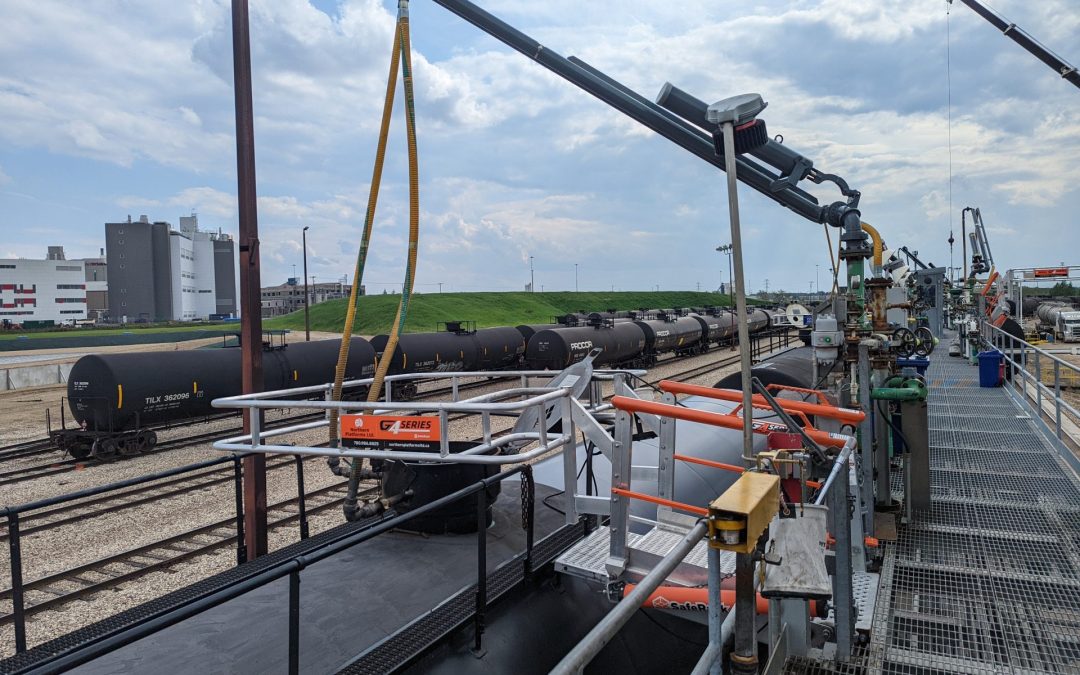
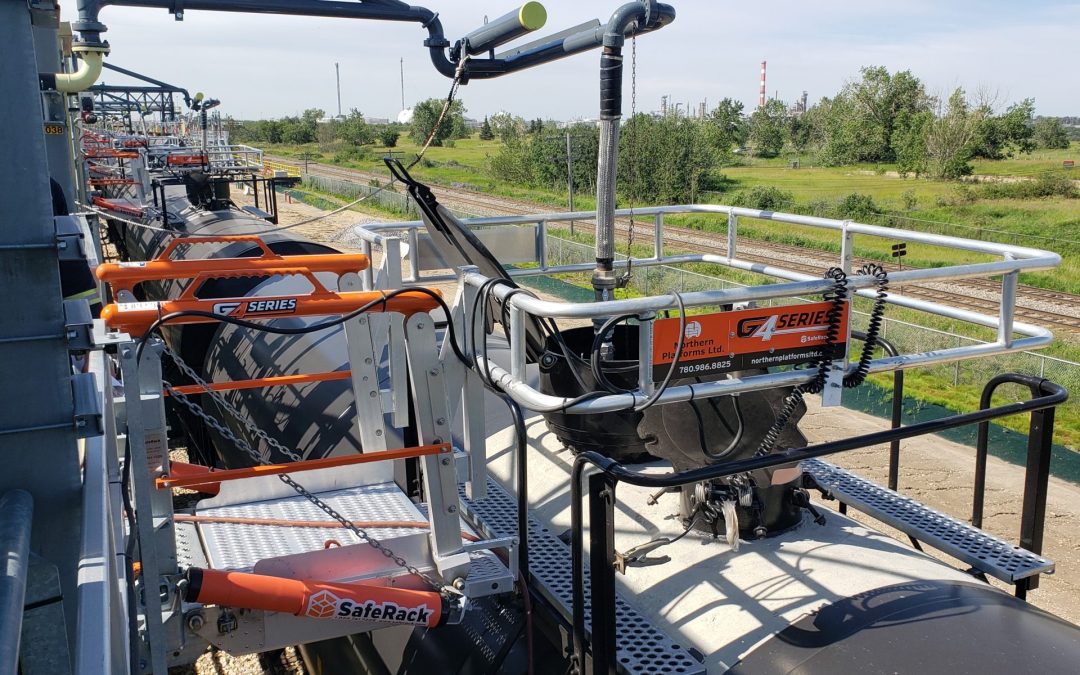
Safety cages: These systems attach to the front of the gangway and enclose the working area around the hatch when it is lowered. Importantly, safety cages create a guardrail barrier between the operator and the edge of the car. They come in 2-rail, 4-rail, or custom designs.
Safety swing gates: Every unsecured elevated opening on a truck or railcar loading platform poses a risk to workers. Safety swing gates are an easy-to-install solution that mounts to existing guardrail systems. Crucially, they are self-closing, which means that no opening is ever left unguarded.
We also offer preventative maintenance programs for gangways and loading arms that are conducted in strict alignment with OEM manufacturer specifications. Post-inspection, every customer receives a colour-coded report (green, yellow, red) that clearly identifies the condition of each component and prioritizes any required action.
Contact Us Today for Truck and Railcar Fall Protection
Whether you are interested in a brand-new railcar fall protection or simply retrofitting existing systems for better worker safety, Northern Platforms can help. Explore our products, request a quote, or call our office to get started!
Portable stairs are one of those pieces of equipment that look simple from the outside but come in more configurations than most buyers expect. The right choice depends on what you’re accessing, how often you’re accessing it, whether the stairs need to move around the site, and what height variability you’re dealing with. This guide covers the four main types of portable stairs Northern Platforms carries, what each one is built for, and how to decide which is right for your application.
Type 1: Fixed Portable Stairs
Fixed portable stairs are prefabricated stair units designed for a set height range — typically used to provide access to a specific entry point, elevated surface, or piece of equipment that doesn’t change. Despite the name, they’re portable in the sense that they can be relocated when needed, but they’re generally positioned and left in place for extended use.
What they’re built for: Trailer and modular building access, elevated platform entry, roof access hatches, construction site office stairs, and any application where a permanent concrete or wood stair isn’t warranted but a stable, compliant access point is needed in one location.
Key specs to look for:
Height range matching your specific application (ErectaStep fixed portable stairs are available in 7 sizes from 28″ to 63″)
IBC, OSHA, and OH&S-compliant construction
Field-adjustable legs for uneven surfaces — essential for outdoor and construction site applications
Slip-resistant tread surface
Platform size adequate for the entry point (4×6′ and 4×4′ platforms available)
Entry configurations: direct, left, right, or multiple entry; double stair options for high-traffic access points
When it’s the right choice: You need a compliant, stable stair at a fixed location and don’t want to build or pour concrete. For temporary site trailers, construction phase access, or any elevated entry that needs to meet code without a permanent structure.
Type 2: Tilt-and-Roll Portable Stairs
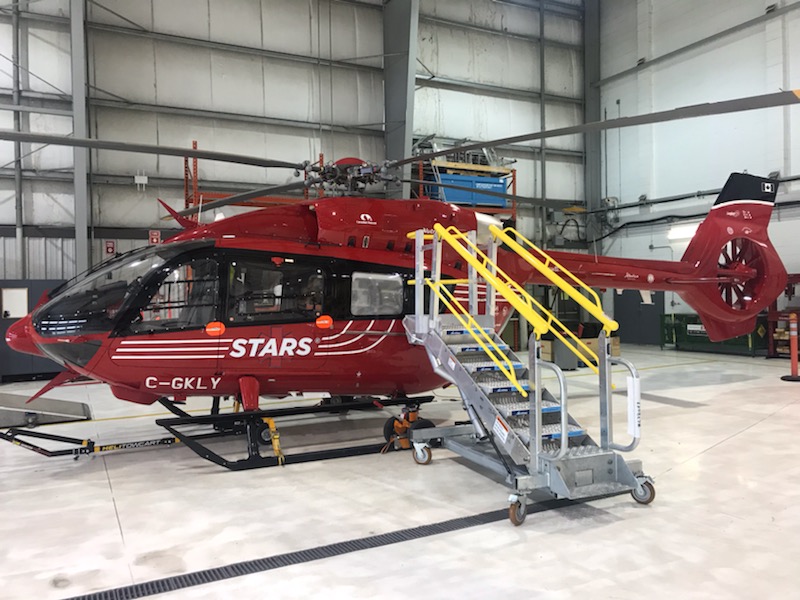
Tilt-and-roll stairs are mobile stair units that can be tilted back on integrated rear wheels to move from one location to another, then set down flat for stable use. A single operator can reposition them without equipment or assistance.
What they’re built for: Warehouses, manufacturing facilities, and distribution centres where workers need to access shelving, mezzanines, or equipment at different points throughout a shift. Anywhere that a stair needs to serve multiple locations on the same floor.
Key specs to look for:
Wheel size and material — larger wheels handle uneven or outdoor surfaces better
Load rating on both the platform and the steps
Handrail configuration — full-height handrails on both sides for industrial applications
Locking mechanism when stationary — caster locks should engage quickly and hold firmly
Step width adequate for carrying tools or equipment while ascending
When it’s the right choice: Your workers need stair access at multiple points in a facility, and repositioning needs to be fast and single-operator. A fixed stair at every location isn’t practical; a tilt-and-roll unit serves the whole area.
Type 3: Rolling Self-Levelling Stairs
Rolling self-levelling stairs take mobility a step further. These units are designed to be repositioned frequently and adjust their platform height to match varying access heights — so the same unit can serve different pieces of equipment or vehicles without reconfiguration. The RollaStep G Series is the leading example of this type: a variable-height, self-levelling stair and platform with gas spring height adjustment and a locking pin to secure the set height.
What they’re built for: Process facilities, tank farms, refineries, and maintenance operations where workers access equipment at multiple heights throughout the day. Loading areas where vehicle or equipment heights vary. Any application where a single stair unit needs to replace multiple fixed-height platforms.
Key specs to look for:
Height adjustment range — the RollaStep G Series adjusts to accommodate a wide range of access heights
Self-levelling step and platform mechanism — steps should automatically level at every height setting, not require manual adjustment
Platform load rating — the G Series carries a 300 lb platform load limit
Caster quality — 360° locking casters with no-flat construction for outdoor and uneven surfaces
Platform size — the G Series provides a 6 square foot work surface, accommodating an operator with tools
Non-slip tread — self-draining, aggressive tread for wet and cold weather conditions
When it’s the right choice: You’re dealing with variable access heights across your site and want one unit that handles all of them. Particularly valuable in oil and gas, chemical processing, and maintenance environments where equipment heights vary, and workers move through multiple tasks in a shift.
Type 4: Cantilever Rolling Stairs
Cantilever rolling stairs are the most specialized type of portable stair — designed for applications where the access point is above or beyond an obstacle that prevents a standard stair from getting close enough. The platform extends out beyond the base of the unit, allowing workers to get above piping, containment walls, tank berms, or vehicle rooflines without the stair base contacting the obstacle or the equipment being serviced.
The RollaStep C Series is the industry standard for this type: a counterweighted cantilever platform that extends 2’5″ beyond the base, with 360° locking swivel casters that allow precise placement around sensitive equipment.
What they’re built for: Tank truck and railcar loading and unloading access, tank hatch access in process facilities, equipment access where piping or containment prevents direct approach, and chemical or petroleum handling environments where contact with the equipment must be avoided.
Key specs to look for:
Cantilever extension length — must reach far enough to position the operator above the access point
Counterweight design — a properly counterweighted unit should be stable with an operator on the platform without tipping
Caster locking — must lock securely before any operator climbs; look for total-lock casters that lock both rotation and swivel
Platform and handrail configuration — full handrails, adequate platform depth for working with equipment or hoses
OSHA compliance — non-negotiable for any industrial application
When it’s the right choice: You’re loading or unloading tank trucks or railcars, accessing tank hatches, or working above or around any obstacle that prevents a standard stair from approaching directly. This is the unit that replaces the improvised ladder-over-the-berm solution that no one should be using.
Portable Stairs from Northern Platforms
Northern Platforms carries the full RollaStep and ErectaStep portable stair lineup. We carry all four types above, and they are in stock and ready to ship. As an authorized distributor with nearly 30 years of experience supplying access equipment to oil and gas, construction, and industrial operations across Western Canada, our team can help you match the right unit to your specific application before you buy. Contact us today to get started!
In many industrial loading environments, loading arms and gangways are treated as separate pieces of equipment. A loading arm may be selected based on reach and flow requirements, while a gangway may be chosen based on platform height and vehicle access.
However, here’s what most site managers don’t realize: these two systems need to communicate. Without proper integration, you’ll be faced with slow operations, increased worker risk, and more.
At Northern Platforms, we specialize in designing and installing completely coordinated truck and railcar loading systems. Keep reading to learn more about the benefits of sourcing both your gangway and your loading arm from the same provider.
How Gangways and Loading Arms Work Together
Gangways and loading arms serve different purposes, but they operate in the same work zone.
The gangway gives operators safe access to the truck or railcar. The loading arm transfers product to or from that same vehicle. In many applications, the operator needs to deploy the gangway, enter the work area, position the loading arm, make the connection, complete the transfer, disconnect the arm, and exit safely.
For that process to work, both systems need to be designed around the same access point, movement path, and operator workflow. The gangway needs to land where the operator works, and the loading arm needs to move into position without interfering with the gangway, safety cage, platform, piping, canopy, or surrounding equipment.
When they are designed together, the full loading process becomes safer, smoother, and easier to operate.
The Risks of a Poorly Designed System
When loading arms and gangways are not designed together, sites may experience several different issues, including:
Clearance conflicts: Both loading arms and gangways have their own movement paths. If these components are not planned together, these systems can collide or block each other.
Poor operator access: Outside of major collisions, small misalignments can force operators into uncomfortable and unsafe positions.
Slower operations: Poor integration can also significantly slow down operations. Every delay, from re-spotting vehicles to moving one loading arm to access another, adds up over time.
Worker risk: In the worst-case scenarios, poorly designed systems can cause unsafe conditions for workers.
Expensive retrofits: Eventually, poorly integrated systems start creating more problems than they solve. At this point, site managers will need to invest in a retrofit or a replacement, which can be expensive and time-consuming.
Choose Northern Platforms for Integrated Loading Systems
Instead of looking at gangways and loading arms as separate purchases, Northern Platforms supports industrial facilities with coordinated loading systems that take your complete environment into account. That includes how the operator accesses the vehicle, where the gangway lands, how the loading arm moves, where the connection is made, and whether the full system supports safe and efficient work.
We work with truck and railcar loading applications across Alberta and British Columbia, helping facilities design systems that account for real site conditions, operator workflow, and long-term performance. Here are the benefits of working with us:
One Provider for Every Aspect of Your Loading Platform
Sourcing your gangway and loading arm from the same provider can make the design process more efficient.
When one team is responsible for the full loading position, it is easier to coordinate:
loading arm reach and movement
gangway location and travel
safety cage placement
platform height and layout
fall protection requirements
This reduces the risk of equipment conflicts and helps ensure the system is designed around how it will actually be used.
Site-Specific and Purpose-Built Design
No two loading environments are exactly the same. For example, a loading system for an LPG terminal may have different requirements than a food processing facility. At Northern Platforms, we take all these factors into account. The result? A system that is uniquely tailored for your application.
Support for New Installations and Retrofits
We have extensive experience supporting both new loading system installations and retrofit projects. For new installations, we can help coordinate the loading arm, gangway, platform, safety cage, and surrounding access equipment from the beginning. This allows the system to be designed with proper clearances, workflow, and equipment movement in mind.
For retrofits, we can review the existing loading area to identify interference points, access issues, structural concerns, and opportunities for improvement. This is especially important for facilities that have expanded or modified their loading systems over time.
Ready to Get Started?
If you are planning a new loading rack, replacing an existing gangway, adding a loading arm, or dealing with an inefficient loading area, Northern Platforms can help. Contact us to start discussing your site today!
Let’s face it: rooftops are filled with hazards. Between exposed pipes, HVAC ducting, cable trays, and unpredictable weather, every trip to the roof is a potential safety incident waiting to happen. The good news? Many of these incidents are entirely preventable—and installing a crossover walkway system is one of the most effective ways to make your rooftop safer, more accessible, and fully compliant with Canadian safety regulations. Keep reading to learn more about this key safe access system!
Rooftop Safety Risks
Every rooftop is different, but the dangers are often the same. Workers performing routine maintenance, inspections, or equipment repairs frequently encounter obstacles that create tripping, slipping, and falling hazards. Common rooftop risks include:
Pipes, conduit, and cable trays running across walking paths
HVAC systems and ductwork that block direct routes
Unprotected edges and parapet walls near work areas
Skylights and roof hatches that create fall-through hazards
Sloped, uneven, or weather-damaged surfaces that become slippery in rain, snow, or ice
These obstacles force workers to improvise—climbing over pipes, stepping around equipment, or walking dangerously close to unprotected roof edges. That’s exactly why a crossover walkway system is so valuable: it gives your team a clear, engineered route over and around rooftop obstructions, eliminating the guesswork and the danger.
What are Crossover Walkways?
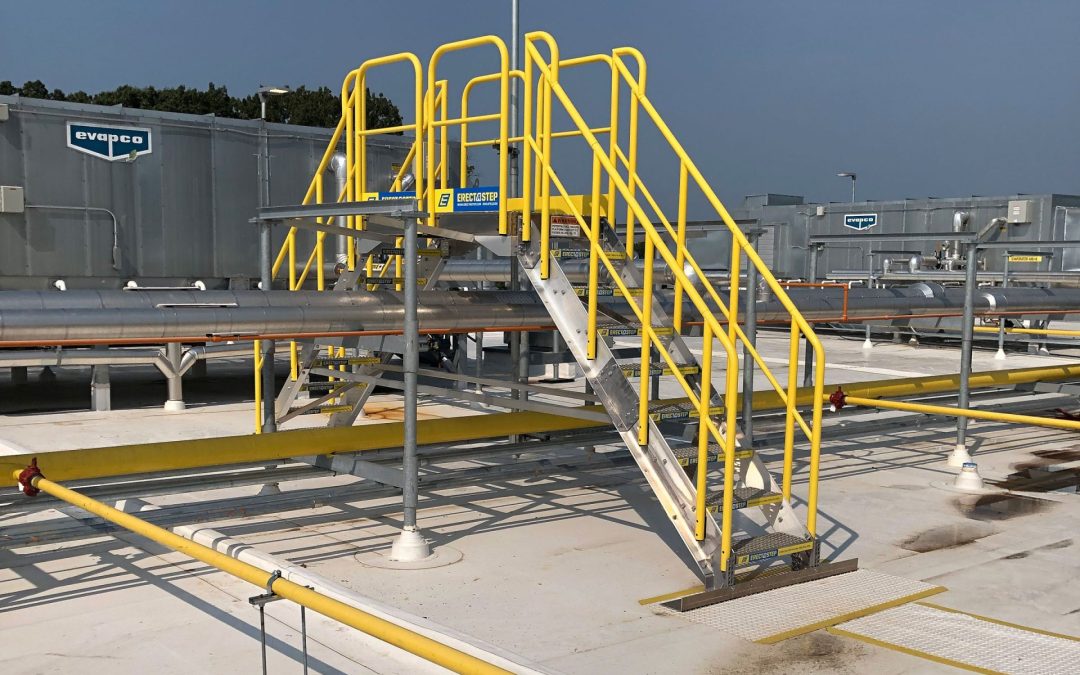
A crossover walkway is a raised, non-penetrating platform system designed to give workers safe passage over rooftop obstacles such as pipes, conduit, HVAC lines, and other obstructions. Rather than stepping over hazards or taking long detours, workers simply walk over and across.
Crossover walkway systems are typically modular, meaning they can be configured and customized to fit the unique layout of your rooftop. Depending on the height of the obstacles and the needs of your operation, a comprehensive rooftop crossover system may include:
Crossover walkways: Flat platforms used when obstacles are low and minimal elevation change is needed
Crossover stairs: Stepped systems ideal for navigating taller or more clustered obstructions, providing elevated clearance and secure footing
Benefits of Rooftop Crossovers
Rooftop crossovers deliver both safety and operational advantages any time workers need to access equipment or travel across the roof. By turning improvised routes into engineered access paths, they help protect people, property, and productivity.
Key benefits include:
Reduced slips, trips, and falls by providing a designated, level path over pipes, conduit, ductwork, and other obstacles.
Protection of the roof membrane by keeping foot traffic off vulnerable areas, reducing punctures, tears, and premature wear.
Safer all-weather access thanks to non-slip treads and stable platforms.
More efficient maintenance work because workers can take the most direct, safe route to rooftop equipment instead of detouring around hazards.
ErectaStep: The Gold Standard in Modular Crossover Walkways
At Northern Platforms, we regularly recommend ErectaStep’s modular crossover platform system for rooftop applications. ErectaStep uses just five standardized components—prefabricated metal stairs, universal platforms, industrial handrails, aluminum ladders, and tower supports—to create a limitless number of modular platform configurations.
Here’s what makes ErectaStep the go-to choice for Canadian operations:
All-aluminum construction that’s as sturdy as steel but significantly lighter
OSHA and OH&S compliant
Quick assembly with no need for welding, fabrication, or special tools required
Fully reusable and reconfigurable
Shorter lead times compared to custom-welded solutions
As a certified ErectaStep supplier, Northern Platforms keeps these systems in stock and ready to ship from our warehouse in Leduc, Alberta. With a digital real-time configuration tool, the team can design, draw, and quote your custom crossover walkway solution within minutes.
Northern Platforms: Your Experts in Rooftop Safety
Ready to make your rooftop operations safer, smarter, and more efficient? As Western Canada’s trusted safe access equipment supplier, Northern Platforms has been helping companies protect their workers since 2002. From crossover walkways and modular platforms to guardrails, safety gates, and more, our team has the expertise and the products you need! Contact us today to learn more about how we can help!
Railcar loading and unloading is no place for guesswork when it comes to working at height. Between changing railcar spots, varying hatch locations, and busy railyards, you need fall protection that keeps operators safe without slowing your operation down. One of the most common questions for rail sites in Western Canada is whether to invest in permanent railcar fall protection systems, rely on temporary or mobile options, or use a combination of both.
Why Railcar Fall Protection Matters
Working on top of railcars exposes operators to significant fall risks, especially during loading, unloading, venting, and inspection. Without the right access and fall protection, it’s easy for “quick checks” to turn into serious incidents.
A complete railcar fall protection strategy typically includes:
Permanent railcar fall protection systems are fixed structures designed into your facility from the start—or added later as part of a major upgrade. These can include single-spot or multi-spot loading platforms with integrated gangways, safety cages, and fall protection built directly into the rack.
Permanent systems are a strong fit when:
You load and unload from the same track locations every day
Your product mix and railcar types are relatively consistent
You want a long-term, engineered solution with minimal reconfiguration
Key advantages of permanent railcar fall protection include:
Consistency. Operators use the same access and fall protection setup each time, which supports training and safe habits.
High throughput. Multi-spot platforms can handle several railcars simultaneously, improving productivity.
Durability. Engineered structures are built for long-term use in harsh Canadian climates, with minimal day-to-day adjustment.
Integrated design. Loading arms, spill containment, and fall protection can be planned together as one system.
For high-volume, fixed-spot rail operations, a permanent platform with integrated gangways and safety cages is often the backbone of the safety plan.
Temporary and Mobile Railcar Fall Protection
On the other hand, temporary or mobile railcar fall protection solutions are designed to move with your operation. Instead of committing to a fixed structure at a single location, mobile systems can be repositioned wherever they’re needed.
These systems are ideal for:
Facilities with multiple tracks or sporadic railcar spots
Sites that see changing railcar types or leasing patterns
Operations that need safe access during shutdowns, outages, or maintenance projects
Locations where a permanent structure isn’t feasible or allowed
Rather than relying on ladders or improvised access, mobile platforms provide a purpose-built, compliant way to get operators safely to the top of the car.
Highlight: SafeRack MAUI Railcar Mobile Access Unit
Northern Platforms supplies SafeRack’s MAUI Railcar Mobile Access Unit—a portable fall protection solution designed specifically for railcar work across multiple locations on your site. This unit combines mobility, stability, and integrated fall protection in one system.
Key features include:
Self-supporting design with a 500 lb load capacity
No-flat tires for reliable movement across railyard surfaces
Double-locking winch for smooth, controlled height adjustment
4-rail safety cage that raises handrail height to 42″ around the hatch area
Slip-resistant walk surface for secure footing in all seasons
Parallel or perpendicular configurations to suit tight spots and different track layouts
Adjustable ladder heights (10′–14′ and 12′–16′ models) to fit varying railcar heights
For operations that need railcar fall protection in more than one spot or that can’t justify a permanent platform on every track, the MAUI provides a practical, compliant way to keep people safe without sacrificing efficiency.
Expert Railcar Fall Protection from Northern Platforms
Ready to explore your railcar fall protection options? The Northern Platforms team is here to help! Explore our products through our website or contact us today for more details!