Industrial and commercial rooftops are working environments.
Maintenance technicians may need to reach HVAC units, exhaust fans, air-handling equipment, ductwork, communications systems, piping, solar equipment, or other rooftop assets. Yet the route to that equipment is often unclear: workers may cross uneven roof surfaces, step around penetrations, navigate over pipes, walk close to skylights, or take indirect paths around mechanical units.
A rooftop safety system should do more than protect workers at the point where maintenance occurs. It should provide a safe, repeatable route from the roof access point to the equipment being serviced.
Many rooftop safety discussions focus on the edge of the building. Roof edges are important, but they are not the only hazard workers face.
The route across the roof can introduce its own risks and inefficiencies. A technician may need to walk around rooftop units, cross piping or ductwork, move through wet or icy areas, pass near skylights, or carry tools and replacement parts over surfaces not designed for regular foot traffic.
When a rooftop does not have a designated access route, every worker may choose a slightly different path. That creates inconsistency, increases the chance of shortcutting, and makes it harder for facility managers to establish reliable rooftop work procedures.
A planned rooftop access walkway creates a clear answer to a simple question: How should a worker safely get from the roof entry point to the equipment?
Common Rooftop Access Challenges
Workers Are Forced to Step Over Obstacles
Ductwork, piping, conduit, cable trays, curbs, and mechanical equipment can interrupt a direct route across the roof. Repeatedly stepping over these obstacles may seem minor, but it can become more difficult when workers are carrying tools, wearing bulky PPE, dealing with poor weather, or navigating the roof in low light.
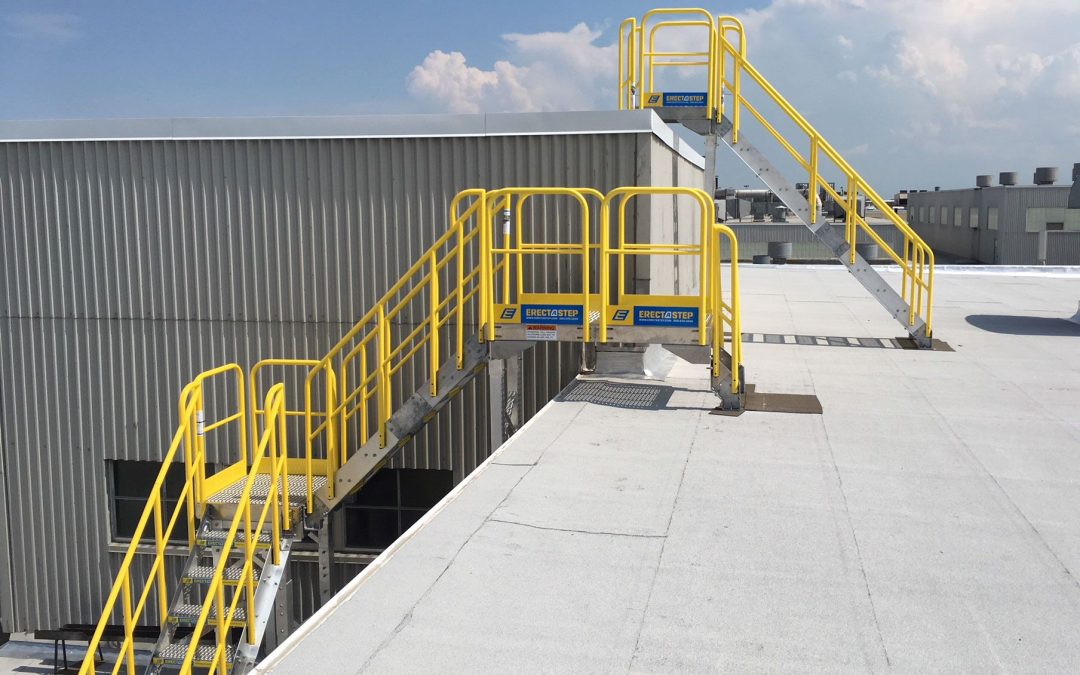
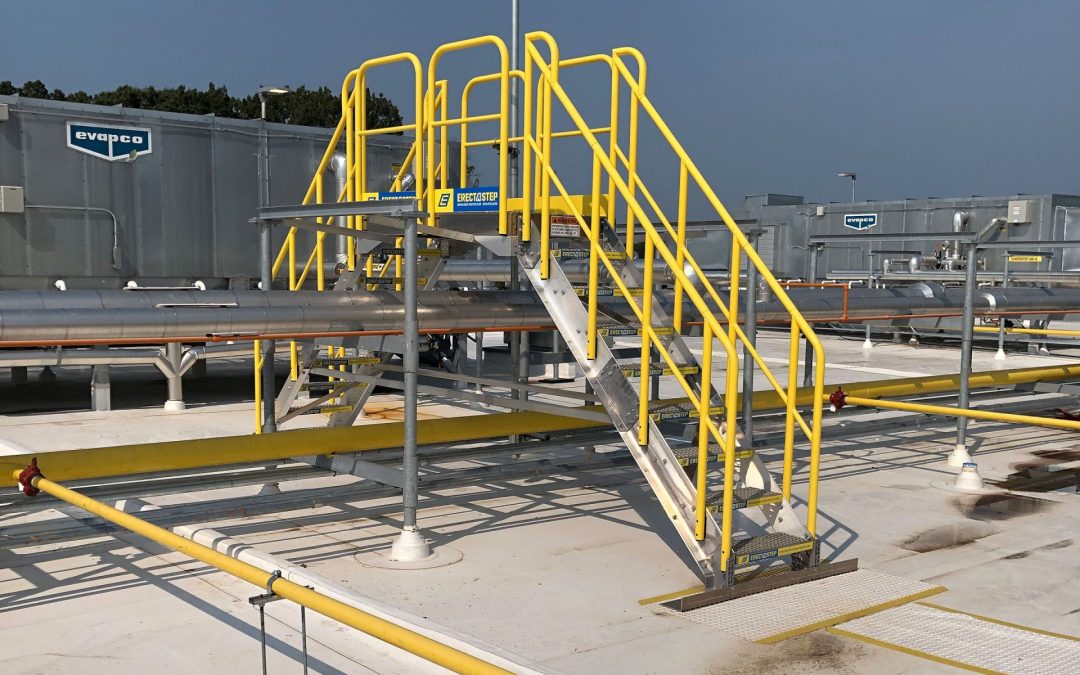
Rooftop crossover stairs provide a defined route over obstructions so workers do not need to climb across equipment or search for a safer way around it.
Service Equipment Is Located Far From the Roof Hatch
A roof hatch or ladder may provide access to the roof, but it does not necessarily provide access to the equipment that needs maintenance. If the HVAC unit is on the opposite side of the building—or separated by a field of ducts, pipes, and rooftop units—the travel path should be considered part of the safety design.
A rooftop walkway system can connect access points to frequently serviced equipment, reducing unnecessary travel across unprotected or difficult roof areas.
Roof Surfaces Are Not Designed for Regular Traffic
Not every roof surface is suitable for repeated foot traffic. Regular walking can affect roofing materials, increase wear in high-traffic areas, and create unstable or uncomfortable footing in wet, icy, or debris-covered conditions.
A purpose-built rooftop walkway provides a more intentional route for maintenance personnel while helping concentrate traffic where it is expected.
There Is No Defined Work Area Around Equipment
Even after workers reach an HVAC unit or fan, they may not have a stable, protected place to stand while performing maintenance. This can be a concern when equipment is near an edge, beside an opening, elevated above the roof surface, or surrounded by other obstacles.
Work platforms, guardrails, and access stairs can create a dedicated maintenance area around rooftop equipment, making routine service more efficient and more predictable.
Components of a Safer Rooftop Access Route
A safe rooftop route is not necessarily one product. It is usually a system of access features selected around the building, the equipment layout, and the tasks maintenance teams perform.
Safe Entry at Roof Hatches and Ladders
The first transition onto the roof is one of the most important areas to assess. Workers need a stable way to step from a hatch, ladder, or access door onto the roof surface without immediately being exposed to an opening, edge, or awkward change in elevation.
Depending on the layout, the solution may include guardrails, self-closing safety gates, handrails, or a small landing platform. Roof openings, hatches, and ladder access points should always receive particular attention during a rooftop safety assessment.
Defined Walkways
A rooftop access walkway creates a designated travel path between entry points and service equipment. It can help workers avoid obstacles, clarify where foot traffic should occur, and support more consistent maintenance routes.
The walkway should be planned around the real path technicians take—not an idealized drawing of the roof. Consider how workers carry tools, where they stop, which units receive the most service, and whether the route remains practical in changing weather conditions.
Crossover Stairs
Where pipes, ducts, conduits, cable trays, or rooftop structures block the path, crossover stairs can provide a safer alternative to climbing over or squeezing around obstacles.
Crossover systems create safer access to rooftop HVAC, ducting, piping, and air-conditioning equipment. The practical benefit is simple: workers gain a clear route across the obstruction rather than having to improvise one.
Protected Maintenance Platforms
Some rooftop assets need more than a walkway. If workers must regularly service equipment in a constrained or exposed location, a dedicated platform can provide the stable working area they need.
A maintenance platform may be appropriate around rooftop HVAC units, fans, access doors, elevated equipment, or other assets where workers need room for inspection, cleaning, repair, or component replacement.
Guardrails and Barriers
Guardrails can provide collective fall protection around exposed edges, roof openings, hatches, elevated work areas, and other locations where workers may be at risk. They are especially valuable because they protect the work area without requiring the worker to connect to an anchor point before every task.
Requirements vary by jurisdiction, building, and application. However, the broader principle remains the same: guardrails, barriers, and properly designed access routes can reduce exposure to rooftop fall hazards and support safer routine work.
Always assess the applicable requirements for the province, site, roof condition, and scope of work before selecting a system.
Non-Penetrating Systems Where Appropriate
One concern with rooftop safety upgrades is preserving the roof membrane. In appropriate applications, non-penetrating guardrails and modular access systems can provide a practical solution without creating unnecessary roof penetrations.
The appropriate approach depends on roof type, structural capacity, wind exposure, equipment layout, manufacturer requirements, and the specific hazards present. A site review is essential before selecting any rooftop system.
Build a Rooftop Route That Works Every Day
Safe rooftop access is not only about reaching the roof. It is about giving workers a reliable way to move across it, around it, and safely into the areas where maintenance actually happens.
Northern Platforms helps facilities create practical rooftop access and fall-protection solutions around their equipment layouts, maintenance needs, and site constraints.
Need a safer route to rooftop HVAC or mechanical equipment? Contact Northern Platforms to discuss rooftop walkways, crossover stairs, guardrails, and modular access platforms.
Alberta’s pipeline sector is moving again. With new oilfield and pipeline projects recently approved across the province, construction and operations teams are returning to the field — and with them comes the full range of access challenges that any active pipeline site presents. Workers need to cross over pipe runs and berm walls. Technicians need safe, stable platforms to reach valves, actuators, and instruments. Metering stations need compliant work surfaces built to support routine inspection and maintenance.
Modular access platforms address all of these needs faster and more cost-effectively than most project teams expect. Here’s what they are, where they fit on a pipeline site, and how Northern Platforms can get them to your project.
Three Applications for Modular Platforms on Pipeline Projects
Pipeline sites create access demands at every stage of construction. The three most common requirements we see on Alberta pipeline projects are crossovers, valve access platforms, and metering station decks.
Pipeline Crossovers
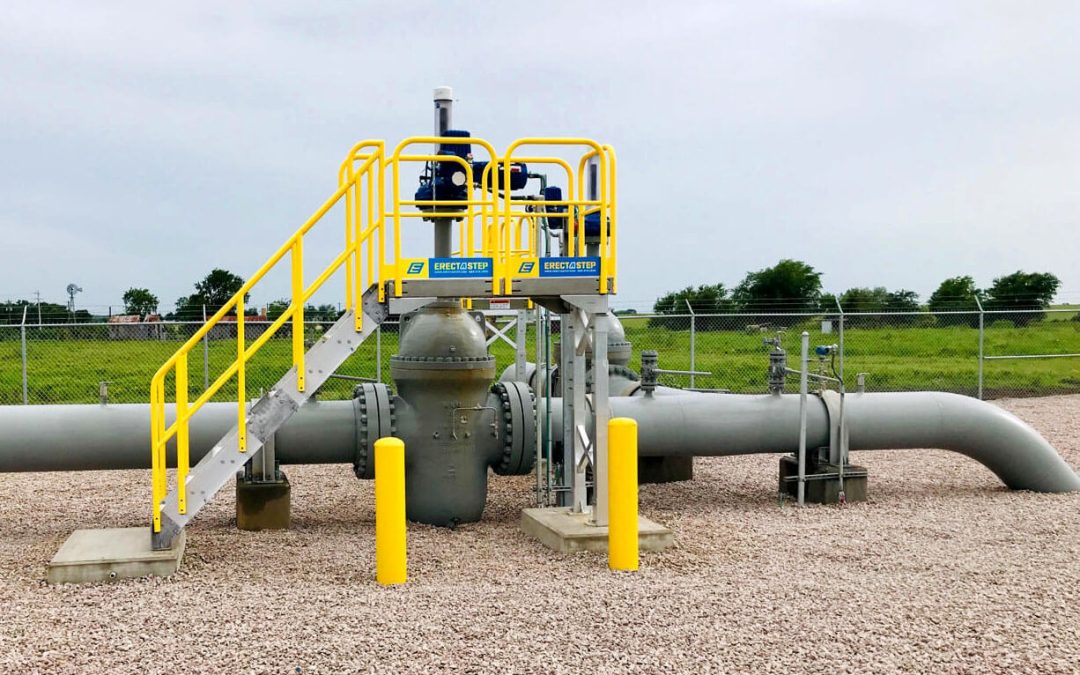
Above-ground pipe runs, containment berms, and valve manifolds create obstacles that workers need to cross safely, repeatedly, and quickly. When no crossover is in place, workers might resort to unsafe crossings. This is when slips, trips, and falls happen.
A modular pipeline crossover provides a safe stairway over the obstruction. ErectaStep crossover units are available in configurations to accommodate a wide range of pipe and berm heights, with anti-slip grating, full guardrails, and self-closing safety gates at both landings.
Because the platforms bolt together without welding or cranes, they can be positioned and reconfigured as construction progresses and pipe routing changes. When the project phase is complete, the same units can be disassembled and redeployed elsewhere on site or at a different facility entirely.
Valve Access Platforms
Isolation valves, check valves, and actuators are often located at height, in tight quarters, or in positions that require a worker to lean, overreach, or improvise access. On the other hand, a properly configured valve access platform puts a stable, compliant work surface directly at the valve—at the right height, with handrails and a safety gate, and enough deck space for a technician to work with both hands.
Metering Station Platforms
Much like valve access platforms, safe access to metering stations is crucial on active worksites. Modular platforms for metering station applications can be configured to provide access at multiple elevations within a single station, with interconnected walkways, stairs, and landings sized to the specific equipment layout. The ErectaStep system’s modular design means platforms can be specified to fit around existing piping and structures without requiring custom engineering drawings — the configuration tool produces accurate schematics in hours, not weeks.
Key Features of Modular Pipeline Platforms from Northern Platforms
The advantages of modular access platforms come down to four things that matter on an active project site:
Speed. ErectaStep units are prefabricated, in stock, and ship immediately. Northern Platforms carries ErectaStep inventory in Alberta, which means no border delays and no waiting on fabrication queues. For a project with a tight construction schedule, that availability can mean the difference between a compliant site and a work stoppage.
Simplicity. ErectaStep platforms bolt together using standard tools. No welding, no crane lifts, no specialty contractors required. A small crew can assemble a complete crossover or valve access platform in hours.
Compliance. Every ErectaStep unit is OSHA and Alberta OHS compliant out of the box — guardrails, anti-slip surfaces, load ratings, and safety gates included. No additional engineering certification required for standard configurations.
Flexibility. Modular platforms aren’t single-use infrastructure. Once a pipeline construction phase wraps up, the same units can be disassembled and reconfigured for a permanent installation at the completed facility — valve access platforms around new equipment, crossovers at permanent piping manifolds, or work platforms at compression and metering stations. The investment travels with the project.
Choose Northern Platforms for Modular Access Platforms
Have an upcoming pipeline project in Alberta and need compliant access platforms on a tight timeline? Contact the Northern Platforms team with your project details for a free quote. For Alberta-based sites, we also offer free site visits and assessments.
Promoting safe access is the cornerstone of all industrial sites. From routine inspections to maintenance, loading, repairs, and equipment operation, workers need reliable ways to reach the areas where work actually happens.
But safe access does not look the same in every facility. Some sites need permanent platforms built around fixed equipment. Others need mobile platforms that can move between work areas. Understanding the difference between these platform types is key to choosing the right solution for your application. In this article, we’ll break down the differences between modular, mobile, and fixed industrial work platforms, including where each option is commonly used and how they support safer, more efficient work.
What Are Industrial Access Platforms?
Industrial access platforms are engineered systems that provide safe, elevated work areas for inspection, maintenance, and operations tasks. They typically combine:
A work deck or platform
Stairs or ladders for access
Guardrails, toe boards, and gates for fall protection
Generally speaking, industrial access platforms fall into three major categories: fixed, modular, and mobile. Let’s break down some key details about all these systems.
Mobile Access Platforms
Mobile access platforms are rolling or movable platforms that can easily be repositioned to where they’re needed and locked in place during use. Typically, you’ll find mobile platforms in applications where:
The work moves around the site (e.g., maintenance on multiple pumps, valves, or vehicles)
Equipment of similar height is spread across a large area
You need temporary access during shutdowns, turnarounds, or project phases
Installing a permanent structure is not practical or cost‑effective
Some examples from Northern Platforms include:
RollaStep MP Series mobile work platforms, which combine the stability of a fixed platform with the mobility of a rolling stair. Ideal for flatbed truck loading and unloading.
SafeRack MAUI Mobile Truck Loading Platform is a mobile tank truck access platform designed for safe loading access. It includes a stable base, telescoping ladder, and safety cage, with optional powered movement for easier positioning.
While mobile platforms can be useful, they should be avoided for high-traffic sites with consistent loading and unloading operations. In these situations, opt for a permanent/fixed loading rack.
Modular Access Platforms
Modular access platforms are built from standardized, pre-engineered components, like stairs, platforms, handrails, ladders, and supports, that bolt together easily. Generally, modular access platforms are ideal for:
Sites where access needs evolve over time
Projects on tight schedules that can’t wait for custom fabrication
Facilities that prefer bolt-together, no-welding installations for safety and speed
Applications where reconfiguration and expansion are expected
Systems like ErectaStep use a small set of standard components (universal platforms, stairs, ladders, tower supports, handrails) that can be combined into almost any configuration: crossovers, valve platforms, mezzanine access, ladder platforms, and more.
In practice, modular systems cover the majority of common industrial use cases, especially for valve access, pipeline crossovers, metering stations, industrial catwalks, rooftop access, and more. However, they are generally not used for truck and railcar loading and unloading.
Fixed Access Platforms
Fixed access platforms are permanently installed structures tied into the building, steelwork, or foundations. They don’t move and are engineered for long-term service in a defined location. Fixed platforms make sense when:
The access need is permanent and clearly defined (e.g., top of a tank, a mezzanine, or a fixed conveyor)
Loads are high or frequent, and continuous anchoring is required
Integration with existing building structure or process equipment is critical
The site must satisfy specific code or insurer requirements for permanent access
Northern Platforms has extensive experience building permanent loading platforms for a variety of applications. For further details about these projects, contact our office.
Industrial Access Platforms from Northern Platforms
Northern Platforms supplies and supports all three categories:
Mobile access platforms: Rolling work platforms and cantilever platforms for safe, mobile access to warehouse shelves, flatbed trailers, and other equipment
Modular access platforms: ErectaStep modular stairs and platforms for crossovers, valve access, metering stations, assembly lines, and more.
Fixed access platforms and loading systems: Truck and rail loading platforms integrating platforms, gangways, loading arms, and fall protection as complete systems.
Not sure what platform is best for your application? Our team specializes in assessing operations and proposing solutions that solve unique issues. For customers based in Alberta, we offer free site visits.
Let’s face it: rooftops are filled with hazards. Between exposed pipes, HVAC ducting, cable trays, and unpredictable weather, every trip to the roof is a potential safety incident waiting to happen. The good news? Many of these incidents are entirely preventable—and installing a crossover walkway system is one of the most effective ways to make your rooftop safer, more accessible, and fully compliant with Canadian safety regulations. Keep reading to learn more about this key safe access system!
Rooftop Safety Risks
Every rooftop is different, but the dangers are often the same. Workers performing routine maintenance, inspections, or equipment repairs frequently encounter obstacles that create tripping, slipping, and falling hazards. Common rooftop risks include:
Pipes, conduit, and cable trays running across walking paths
HVAC systems and ductwork that block direct routes
Unprotected edges and parapet walls near work areas
Skylights and roof hatches that create fall-through hazards
Sloped, uneven, or weather-damaged surfaces that become slippery in rain, snow, or ice
These obstacles force workers to improvise—climbing over pipes, stepping around equipment, or walking dangerously close to unprotected roof edges. That’s exactly why a crossover walkway system is so valuable: it gives your team a clear, engineered route over and around rooftop obstructions, eliminating the guesswork and the danger.
What are Crossover Walkways?
A crossover walkway is a raised, non-penetrating platform system designed to give workers safe passage over rooftop obstacles such as pipes, conduit, HVAC lines, and other obstructions. Rather than stepping over hazards or taking long detours, workers simply walk over and across.
Crossover walkway systems are typically modular, meaning they can be configured and customized to fit the unique layout of your rooftop. Depending on the height of the obstacles and the needs of your operation, a comprehensive rooftop crossover system may include:
Crossover walkways: Flat platforms used when obstacles are low and minimal elevation change is needed
Crossover stairs: Stepped systems ideal for navigating taller or more clustered obstructions, providing elevated clearance and secure footing
Benefits of Rooftop Crossovers
Rooftop crossovers deliver both safety and operational advantages any time workers need to access equipment or travel across the roof. By turning improvised routes into engineered access paths, they help protect people, property, and productivity.
Key benefits include:
Reduced slips, trips, and falls by providing a designated, level path over pipes, conduit, ductwork, and other obstacles.
Protection of the roof membrane by keeping foot traffic off vulnerable areas, reducing punctures, tears, and premature wear.
Safer all-weather access thanks to non-slip treads and stable platforms.
More efficient maintenance work because workers can take the most direct, safe route to rooftop equipment instead of detouring around hazards.
ErectaStep: The Gold Standard in Modular Crossover Walkways
At Northern Platforms, we regularly recommend ErectaStep’s modular crossover platform system for rooftop applications. ErectaStep uses just five standardized components—prefabricated metal stairs, universal platforms, industrial handrails, aluminum ladders, and tower supports—to create a limitless number of modular platform configurations.
Here’s what makes ErectaStep the go-to choice for Canadian operations:
All-aluminum construction that’s as sturdy as steel but significantly lighter
OSHA and OH&S compliant
Quick assembly with no need for welding, fabrication, or special tools required
Fully reusable and reconfigurable
Shorter lead times compared to custom-welded solutions
As a certified ErectaStep supplier, Northern Platforms keeps these systems in stock and ready to ship from our warehouse in Leduc, Alberta. With a digital real-time configuration tool, the team can design, draw, and quote your custom crossover walkway solution within minutes.
Northern Platforms: Your Experts in Rooftop Safety
Ready to make your rooftop operations safer, smarter, and more efficient? As Western Canada’s trusted safe access equipment supplier, Northern Platforms has been helping companies protect their workers since 2002. From crossover walkways and modular platforms to guardrails, safety gates, and more, our team has the expertise and the products you need! Contact us today to learn more about how we can help!
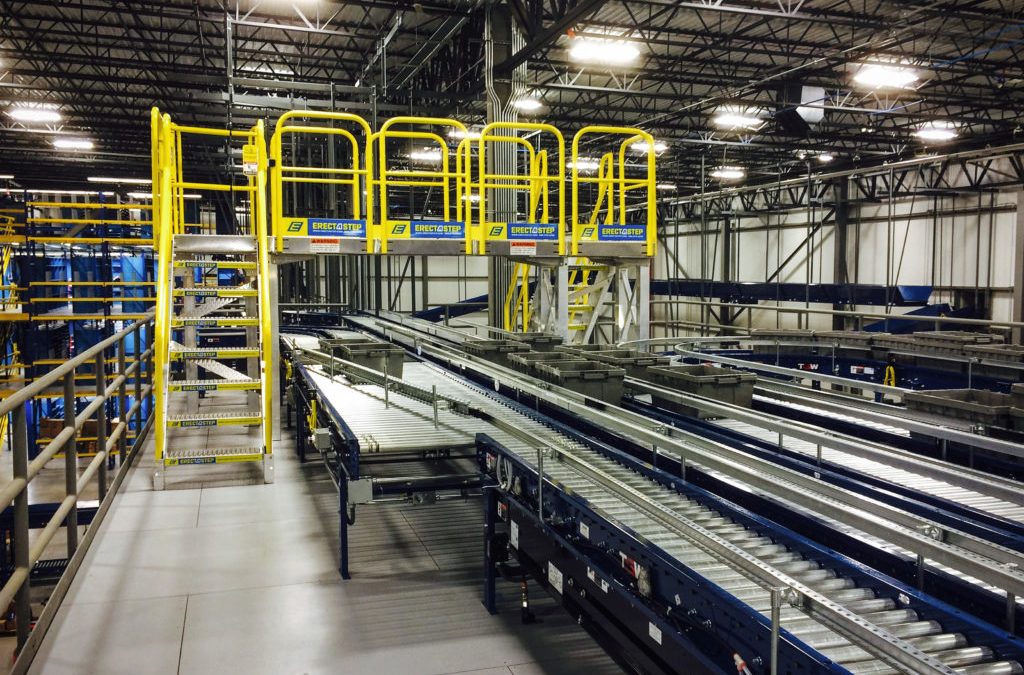
Assembly lines are constantly evolving. Whether you operate in food processing, pharmaceutical manufacturing, packaging, or heavy industrial production, layouts shift, equipment moves, and new lines are added as operations grow. Looking for a system that accommodates these changes with ease? Modular access platforms provide a flexible solution for facilities that rely on conveyor systems, bottling lines, packaging stations, and elevated inspection points. Keep reading to learn more
Access Challenges for Production Facilities
Modern production environments are busy, compact, and full of potential trip and fall hazards. As new equipment is added and conveyor routes change, it’s common to see temporary ladders, step stools, and makeshift platforms appear on the floor just to “get by” for day-to-day tasks. Over time, this patchwork approach increases risk and slows operators down.
Common access challenges include:
Navigating over and around conveyors, bottling lines, and packaging equipment without interrupting production.
Providing safe, repeatable access to elevated inspection points, maintenance panels, and valves.
Maintaining clear egress routes and emergency access while equipment layouts change.
Staying compliant with safety regulations and internal corporate standards as lines expand or shift.
Without a properly engineered access solution, operators end up taking longer routes, performing unsafe climbs, or relying on non-compliant equipment that was never intended for industrial use. Modular access platforms address these challenges by creating permanent, code-compliant pathways that integrate directly into the production environment.
Modular Access Platforms for Food and Beverage Facilities
In food and beverage facilities, access isn’t just about convenience—it’s also about hygiene, product quality, and audit readiness. Spills, washdowns, and frequent cleaning cycles can turn improvised access solutions into serious slip and contamination risks.
Modular access platforms are particularly well-suited to food and beverage applications because they:
Create designated crossover points over conveyors, mixers, tanks, and packaging lines, keeping operators away from moving components and splash zones.
Use materials and finishes that stand up to washdowns and high-moisture environments, helping support sanitation programs.
Make it easier for quality and maintenance teams to reach inspection points, weigh scales, sensors, and control panels without disrupting production.
Can be reconfigured as recipes, SKUs, or packaging formats change, ensuring the access solution grows with the line instead of holding it back.
Instead of rebuilding catwalks or welding new structures every time a line is modified, facilities can adjust modular platforms to match the new layout, minimizing downtime and construction work inside sensitive production areas.
Why Choose ErectaStep Modular Access Platforms
Northern Platforms supplies high-quality modular systems from ErectaStep, one of the industry’s most trusted manufacturers of industrial access solutions. Key features of these systems include:
Pre-engineered, bolt-together components
Durable industrial-grade construction
Reconfigurable stair and platform modules
Guardrail systems designed for compliance and safety
Rapid installation with minimal site disruption
For facilities that expect change, ErectaStep’s modular design makes it possible to modify existing installations rather than replace them entirely. When combined with Northern Platforms’ turnkey support, from layout consultation to installation, your facility receives a solution tailored to your operational needs.
Contact Northern Platforms Today
Does your operation need safe crossover points or elevated inspection areas that integrate into your operation with ease? The Northern Platforms team is here to help. As the leading ErectaStep supplier in Western Canada, we can design, assemble, and install your modular access platforms in no time. With over 20 years of experience, we have completed hundreds of successful projects in the oil and gas, food processing, and pharmaceutical industries.
With almost 20% of all workplace injuries from falling from heights, it is no surprise that rooftop safety remains a critical concern across many Alberta industries. Do your workers regularly access elevated areas for maintenance, inspections, or operational tasks? Are you looking for a safe access solution that easily addresses key safety concerns? Using a real-world case study from Alberta’s food processing sector, this post will explain how modular access platforms can prevent falls without compromising structural integrity, and how the expert team at Northern Platforms can help.
The Problem: Complex Rooftop Safety Concern
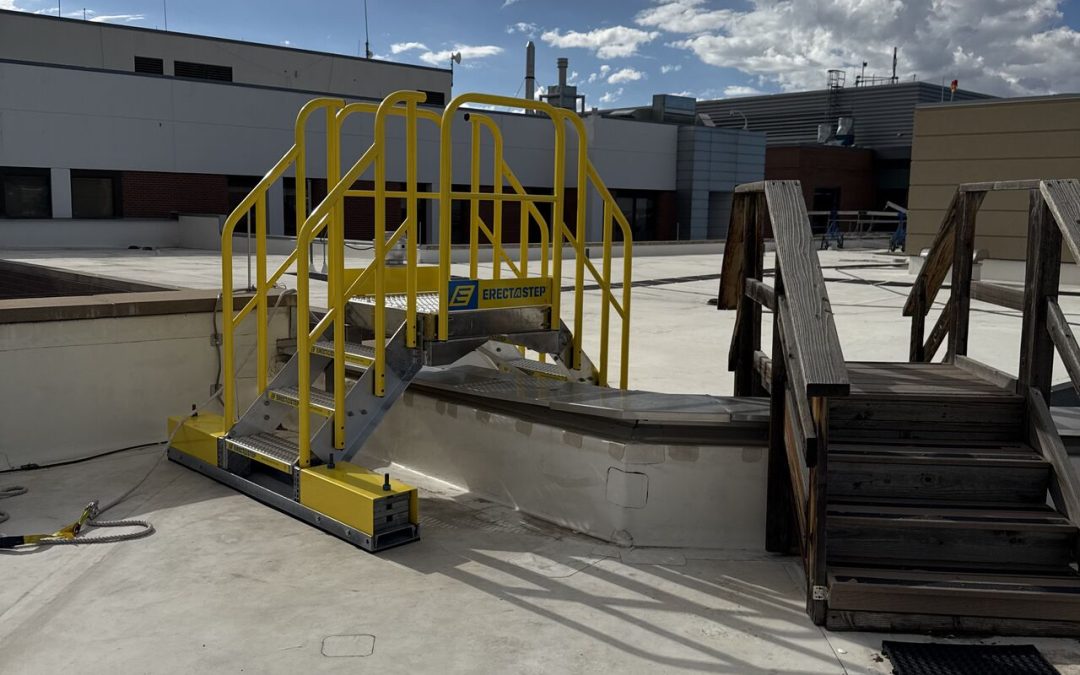
As reported by OHS Canada, a third of fatal construction falls occur from unsecured rooftop access points, poor edge awareness, and other rooftop construction risks. For example, consider a food processing plant located in Central Alberta. Recently, facility managers identified a rooftop safety concern that required quick attention. In order to complete rooftop inspections and servicing, workers at this plant had to regularly cross a parapet wall separating two roof areas with different elevations. Each side required different stair lengths for safe access, meaning a simple crossover unit wasn’t suitable. Additionally, no proposed rooftop solution could penetrate the rooftop, making securing any available access units hard.
The Solution: Modular Access Platforms
Once contacted, the Northern Platforms team immediately got to work and scheduled a site visit within 24 hours. Once we assessed the main safety concern, we designed a system that easily accommodated the plant’s needs.
Part 1: Engineered Non-Penetrating Base
Before we could create the access unit, our team had to devise a creative solution that allowed us to secure the stairs and walkways without penetrating the roof. To do this, we made a solid base out of steel channels that evenly distributed the weight, allowing us to secure all stairs and access units.
Phase 2: Adjustable Stair System
Next, we got to work creating a custom ErectaStep system that accommodated the site’s demands. Using the ErectaStep configurator, we had designs of a potential system within hours. Once the designs were approved, our team installed in-stock modular platforms and components to create a comprehensive system that offered total rooftop protection.
Phase 3: Complete Fall Protection
Within one week, our Leduc team installed a complete rooftop safety system, which included:
A custom non-penetrating base structure
Adjustable stair components to accommodate both roof elevations
Protective handrails, guardrails, and self-closing safety swing gates
At the end of the day, the staff at this food processing plant were extremely grateful for our local expertise, quick response times, prompt site visits, and fit-for-purpose solutions.
The Local Advantage: Choose Northern Platforms
Is your plant, site, or warehouse located in Alberta? When you partner with Northern Platforms, you aren’t just getting over 20 years of industry expertise–you are getting a local partner who will put your needs first. As Alberta’s leading ErectaStep provider, our team offers:
Quick Response Times: Same-day site visits (if possible) and turnaround times that exceed industry standards.
Local Expertise: Our team has dealt with the Canadian climate since the beginning. You can count on us for a solution that performs, no matter the weather.
Complete Turnkey Services: From consultation to installation to maintenance, our experts are with you every step of the way. Contact us today to learn more about our installation services and maintenance programs!
Get Started Today!
Ready to improve your site’s rooftop safety? Contact our Alberta-based safe access team at 780-986-8825 to schedule a site visit today!