Loading arms are some of the hardest-working pieces of equipment on an industrial site. In truck and rail loading applications, operators rely on them every shift to move product safely, connect cleanly, and keep loading operations running as they should.
But without a proper maintenance program, reliable loading equipment can quickly become a source of leaks, downtime, and safety hazards. Seals wear down. Couplers collect dirt and debris. Swivels loosen. Balance mechanisms drift out of adjustment. In Alberta’s outdoor industrial environments, snow, ice, freeze–thaw cycles, and de-icing chemicals can accelerate that wear even further.
That’s why Northern Platforms provides loading arm maintenance, inspection, and repair services for Alberta industrial sites. Regular maintenance helps identify issues early, extend equipment life, and keep loading arms working safely alongside your truck and rail loading platforms. In this article, we’ll discuss some simple loading arm maintenance tips and how our team can help.
1. Inspect Seals, O-Rings, and Couplers for Wear
Seals are one of the most important maintenance items on a loading arm. They are also one of the most application-specific.
The correct seal material depends on the product being transferred, the operating temperature, the additives in the product, and the chemical compatibility requirements of the site. Using the wrong seals can compromise the rest of your loading arm, leading to product leaks and other long-term issues.
During inspection, maintenance teams should check:
Whether the seal material is compatible with the product
Whether seals are rated for the expected temperature range
Whether seals are cracked, flattened, swollen, hardened, or torn
Whether nose seals and O-rings show early signs of wear
Whether replacement seals follow the manufacturer’s changeout procedure
2. Keep Latches, Handles, and Couplers Clean
Loading arm couplers come into contact with multiple trucks or railcars, and every connection creates an opportunity for dirt, product residue, ice, or debris to collect on the equipment. In the long-term, this build-up can create a flawed seal and may prevent the coupler from latching correctly to the truck adaptor.
To prevent this, operators and maintenance teams should regularly inspect and clean:
Coupler faces
Latch areas
Handles
Locking mechanisms
Sealing surfaces
Parking adaptors
Vapour recovery connections, where applicable
In other words, a coupler that does not latch cleanly should be inspected before loading continues. Forcing the connection may damage the coupler, compromise the seal, or create an unsafe loading condition.
3. Check Loading Arm Balance and Movement
A properly balanced loading arm should be easy for an operator to move into position. It should not drop unexpectedly, require excessive lifting force, or sit too low for ergonomic connection.
Over time, these systems can drift, making it harder and harder for operators to connect to the tanker.
During inspection, maintenance teams should check:
Whether the arm stays where it is positioned
Whether the operator must force the arm up or down
Whether the coupler sits at the correct loading height
Whether the arm returns safely to its parked position
Whether the adjustment hardware is secure and in good condition
Whether the arm moves smoothly through its full operating range
If a loading arm suddenly feels heavier, drops faster than expected, or no longer parks correctly, it should be inspected before continued use.
4. Confirm the Loading Arm Does Not Clash With Gangways or Platforms
Loading arms do not operate in isolation. They usually work alongside platforms, gangways, safety cages, guardrails, pipe supports, vapour recovery arms, and vehicle access systems.
That means maintenance should include a review of how the loading arm moves within the full loading area. Remember to check that the loading arm can move freely without clashing with nearby obstructions.
5. Include the Platform, Gangway, and Safety Cage in the Inspection
Loading arm maintenance should not stop at the arm itself. Operators rely on the full access system to load trucks and railcars safely.
As part of a broader inspection, check:
Gangway hinges, pins, springs, and gas shocks
Safety cage alignment and weld condition
Guardrails, toe boards, and self-closing gates
Platform grating and slip resistance
How Northern Platforms Can Help
Northern Platforms supports Alberta industrial sites with inspection, repair, and maintenance services for loading arms, gangways, and other truck and rail loading platform systems.
Our maintenance work is completed according to the applicable manufacturer manuals and service requirements for the equipment on site. This helps ensure that loading arms, couplers, swivels, seals, balance mechanisms, gangways, and related components are inspected and serviced using the correct procedures for that specific system.
After the inspection, Northern Platforms provides a clear, easy-to-read report outlining the condition of the equipment, any issues identified, and practical recommendations for repair, replacement, or ongoing maintenance. This gives your team a straightforward record of what was reviewed, what needs attention, and what steps can help keep the loading area operating safely and reliably.
Contact Northern Platforms for Truck and Rail Loading Platform Maintenance
If your loading arms are becoming harder to move, showing signs of wear, or overdue for inspection, Northern Platforms can help. Contact us today to schedule your first site assessment!
Falls from height remain one of the most serious hazards in truck and railcar loading operations, especially when fall protection equipment is not used properly. At Northern Platforms, we specialize in designing and installing systems that go above and beyond to protect workers and eliminate this risk. Keep reading to learn more about the SavkoLock Mechanica Gangway Lockdown system and how it can improve your site’s safety today.
The Problem: Unsafe Gangway Movement
Fall protection, like gangways and safety cages, is essential for all industrial sites. But here’s the truth: despite proper design and specifications, these systems can still create worker safety risks.
For example, consider this situation: In dry bulk and other multi-hatch truck operations, gangway systems often have to be moved or repositioned during loading, unloading, or inspection. In the proper procedure, the operator completes their task on top of the vehicle, walks back to the loading platform, tracks the gangway to the next hatch, lowers it to the new position, and climbs back on top of the vehicle.
Unfortunately, many operators skip these steps. Instead of returning to the platform, they attempt to lift and reposition the gangway while still standing on top of the vehicle. This unauthorized maneuver is a leading cause of accidental falls in loading bays.
The Solution: SavkoLock Mechanical Gangway Lockdown
As we’ve outlined, the above situation poses a significant falling hazard for workers. That’s why Northern Platforms and SafeRack created the SavkoLock Mechanical Gangway Lockdown system.
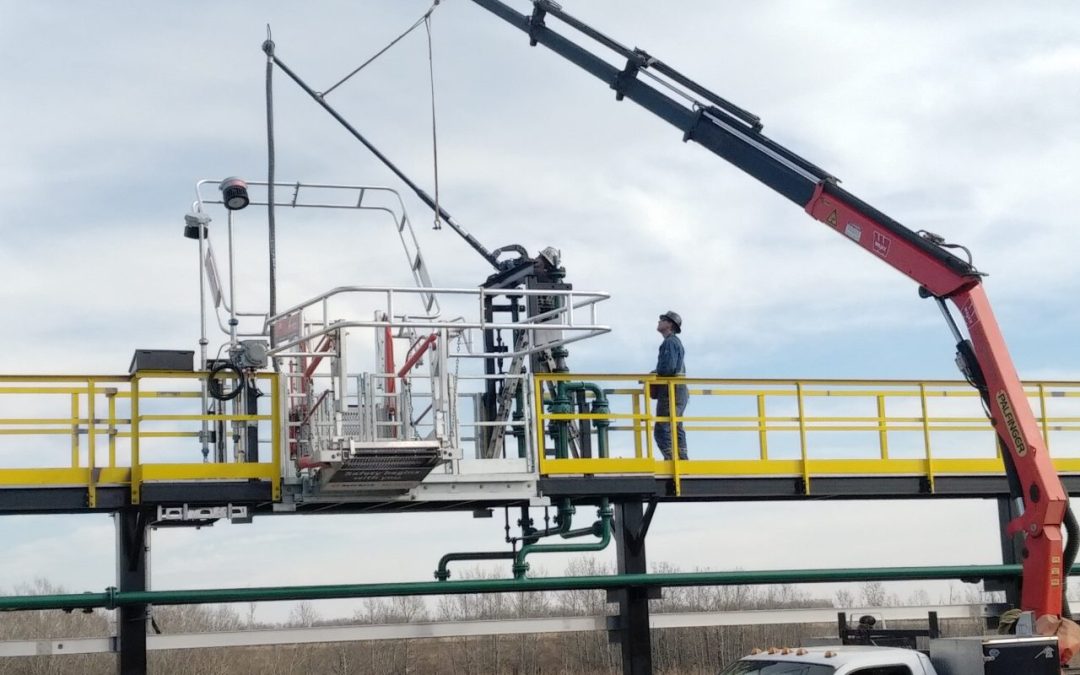
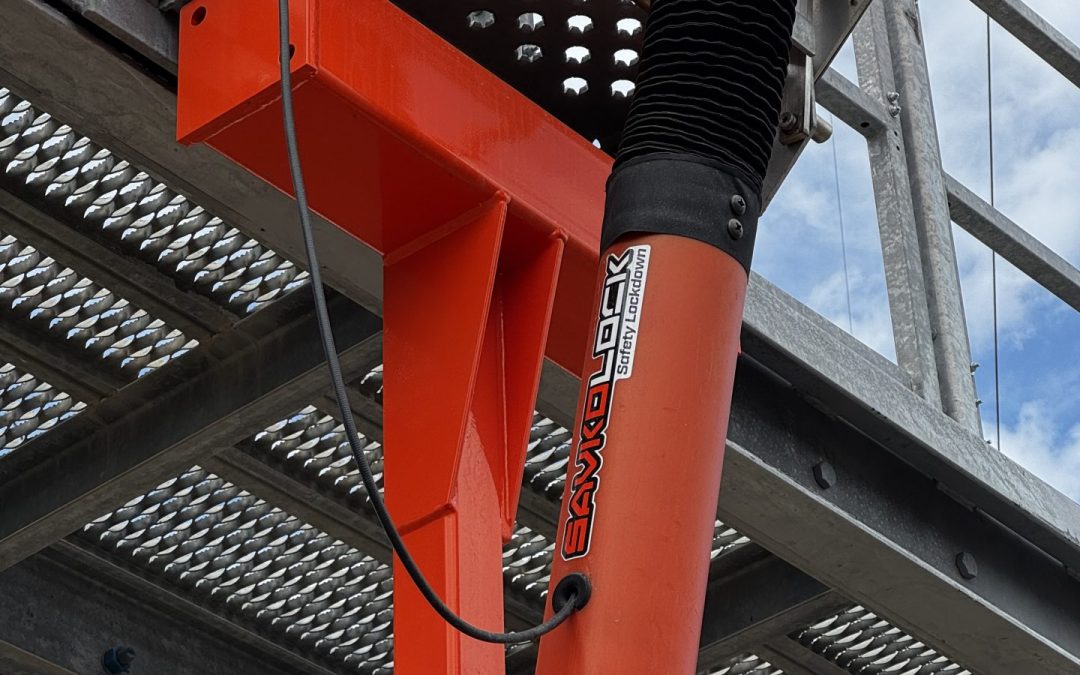
The function of this system is simple: When the gangway is lowered onto the vehicle, it automatically engages and locks the gangway in the deployed position. While locked, the gangway cannot be lifted, shifted, or adjusted from on top of the vehicle. Once the operator completes their task, they must return to the loading platform and use a foot pedal to release the lock. Since the pedal is located on the platform rather than the truck, the SavkoLock effectively discourages unsafe gangway procedures and ensures proper, comprehensive fall protection.
The SavkoLock was developed through close collaboration between SafeRack and the General Manager of Northern Platforms, Rob Sawchuk. This product demonstrates our unwavering commitment to worker safety in all situations, even the coldest Canadian temperatures.
SavkoLock Product Details
Included T-Frame support structure and mounting brackets, cabling and connections, and protective covers.
Suitable for use in ambient temperatures up to -40°C.
Assemblies available for 24”, 36”, and 48” G4 gangways.
Can be purchased with new gangway systems or retrofitted onto existing G4 gangways from SafeRack.
Easily interchangeable with the previous SafeRack SafeLok solution.
Do you have additional questions about this gangway lockdown system? Contact Northern Platforms through our website or at (780) 986-8825 for more information!
Additional Fall Protection Upgrades Available from Northern Platforms
As Western Canada’s leading experts in truck and railcar fall protection and SafeRack’s Platinum Partner of the Year for 2025, Northern Platforms helps improve the safety of industrial sites every single day. In addition to the SavkoLock, we also stock and supply a variety of other SafeRack products, including:
Safety cages: These systems attach to the front of the gangway and enclose the working area around the hatch when it is lowered. Importantly, safety cages create a guardrail barrier between the operator and the edge of the car. They come in 2-rail, 4-rail, or custom designs.
Safety swing gates: Every unsecured elevated opening on a truck or railcar loading platform poses a risk to workers. Safety swing gates are an easy-to-install solution that mounts to existing guardrail systems. Crucially, they are self-closing, which means that no opening is ever left unguarded.
We also offer preventative maintenance programs for gangways and loading arms that are conducted in strict alignment with OEM manufacturer specifications. Post-inspection, every customer receives a colour-coded report (green, yellow, red) that clearly identifies the condition of each component and prioritizes any required action.
Contact Us Today for Truck and Railcar Fall Protection
Whether you are interested in a brand-new railcar fall protection or simply retrofitting existing systems for better worker safety, Northern Platforms can help. Explore our products, request a quote, or call our office to get started!
Alberta’s pipeline sector is moving again. With new oilfield and pipeline projects recently approved across the province, construction and operations teams are returning to the field — and with them comes the full range of access challenges that any active pipeline site presents. Workers need to cross over pipe runs and berm walls. Technicians need safe, stable platforms to reach valves, actuators, and instruments. Metering stations need compliant work surfaces built to support routine inspection and maintenance.
Modular access platforms address all of these needs faster and more cost-effectively than most project teams expect. Here’s what they are, where they fit on a pipeline site, and how Northern Platforms can get them to your project.
Three Applications for Modular Platforms on Pipeline Projects
Pipeline sites create access demands at every stage of construction. The three most common requirements we see on Alberta pipeline projects are crossovers, valve access platforms, and metering station decks.
Pipeline Crossovers
Above-ground pipe runs, containment berms, and valve manifolds create obstacles that workers need to cross safely, repeatedly, and quickly. When no crossover is in place, workers might resort to unsafe crossings. This is when slips, trips, and falls happen.
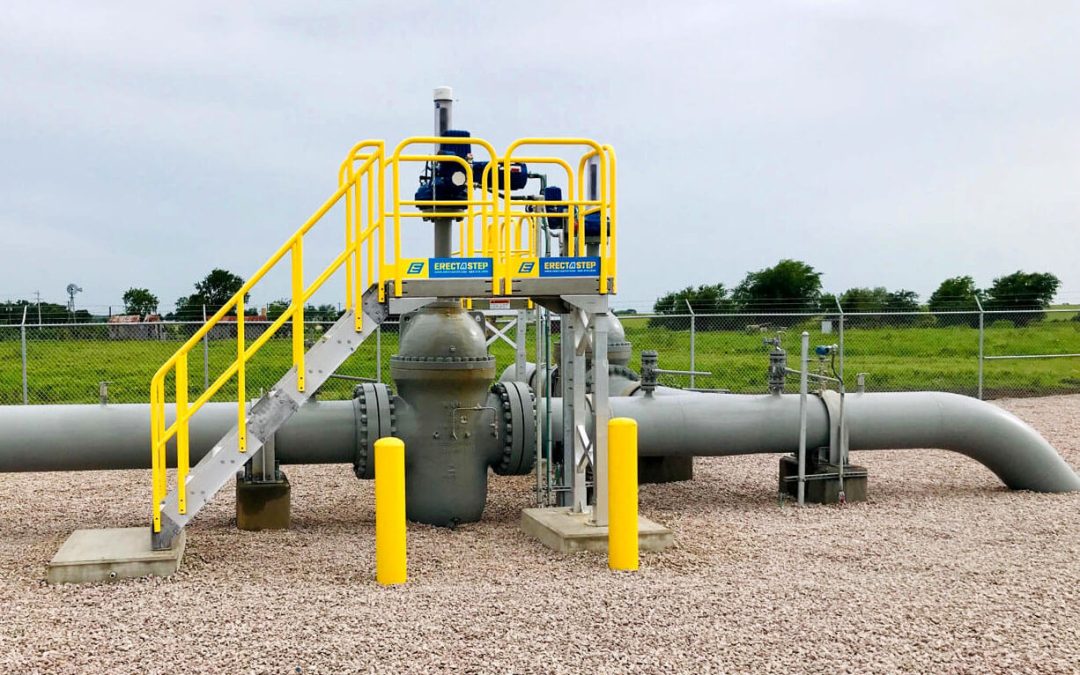
A modular pipeline crossover provides a safe stairway over the obstruction. ErectaStep crossover units are available in configurations to accommodate a wide range of pipe and berm heights, with anti-slip grating, full guardrails, and self-closing safety gates at both landings.
Because the platforms bolt together without welding or cranes, they can be positioned and reconfigured as construction progresses and pipe routing changes. When the project phase is complete, the same units can be disassembled and redeployed elsewhere on site or at a different facility entirely.
Valve Access Platforms
Isolation valves, check valves, and actuators are often located at height, in tight quarters, or in positions that require a worker to lean, overreach, or improvise access. On the other hand, a properly configured valve access platform puts a stable, compliant work surface directly at the valve—at the right height, with handrails and a safety gate, and enough deck space for a technician to work with both hands.
Metering Station Platforms
Much like valve access platforms, safe access to metering stations is crucial on active worksites. Modular platforms for metering station applications can be configured to provide access at multiple elevations within a single station, with interconnected walkways, stairs, and landings sized to the specific equipment layout. The ErectaStep system’s modular design means platforms can be specified to fit around existing piping and structures without requiring custom engineering drawings — the configuration tool produces accurate schematics in hours, not weeks.
Key Features of Modular Pipeline Platforms from Northern Platforms
The advantages of modular access platforms come down to four things that matter on an active project site:
Speed. ErectaStep units are prefabricated, in stock, and ship immediately. Northern Platforms carries ErectaStep inventory in Alberta, which means no border delays and no waiting on fabrication queues. For a project with a tight construction schedule, that availability can mean the difference between a compliant site and a work stoppage.
Simplicity. ErectaStep platforms bolt together using standard tools. No welding, no crane lifts, no specialty contractors required. A small crew can assemble a complete crossover or valve access platform in hours.
Compliance. Every ErectaStep unit is OSHA and Alberta OHS compliant out of the box — guardrails, anti-slip surfaces, load ratings, and safety gates included. No additional engineering certification required for standard configurations.
Flexibility. Modular platforms aren’t single-use infrastructure. Once a pipeline construction phase wraps up, the same units can be disassembled and reconfigured for a permanent installation at the completed facility — valve access platforms around new equipment, crossovers at permanent piping manifolds, or work platforms at compression and metering stations. The investment travels with the project.
Choose Northern Platforms for Modular Access Platforms
Have an upcoming pipeline project in Alberta and need compliant access platforms on a tight timeline? Contact the Northern Platforms team with your project details for a free quote. For Alberta-based sites, we also offer free site visits and assessments.
Does your operation have the equipment it needs? If not, Northern Platforms is here to help. As a leading Western Canada supplier of SafeRack and OPW products, our team specializes in building railcar loading and unloading systems that protect workers and maintain throughput at the same time. Keep reading to learn more about the different types of railcar loading arms and platforms that we offer, broken down by application.
Common equipment considerations: Loading arm, grounding/bonding, vapour management where required, overfill protection, spill containment, gangway or access platform, fall protection, heated or jacketed components
Railcar Loading Systems for Refined Fuels (Gasoline, Diesel, Jet Fuel)
Refined fuels such as gasoline, diesel, and jet fuel require loading systems that support fast, controlled, and clean transfer. Because these products are flammable or combustible, the system must be designed to reduce ignition risk, control vapours where required, prevent spills, and keep workers safely positioned during loading. Key design considerations for refined fuel loading systems include:
Type of railcar: General service tank car for flammable or combustible liquids
Type of loading: Top or bottom loading; gasoline is commonly handled with closed loading and vapour recovery (where required)
Common equipment considerations: Loading arm, dry disconnect or tight-fill couplers, vapour recovery arm or line, grounding/bonding, overfill protection, emergency shutoff system, gangway or access platform, fall protection
Railcar Loading Systems for Natural Gas/LPG (Propane, Butane)
Liquified petroleum gas (LPG) is transported in pressurized tank cars and presents a very different risk profile than crude bitumen or refined fuels. Loading systems must maintain proper pressure during loading and unloading. Additionally, platforms and racks must meet strict industry standards (NFPA 53). Key considerations for these loading systems include:
Common equipment considerations: Pressure-rated loading arm, secure couplers, emergency shutoff valves, breakaway protection, vapour return or equalization line where required, gas detection, gangway or access platform, fall protection
Railcar Loading Systems for Ammonia (NH3)
Railcar loading systems for LPG and ammonia share several characteristics. Both products are transported under pressure, both require secure connections, and both rely on closed transfer systems to maintain containment. However, ammonia introduces an additional layer of risk: it is highly hazardous to workers if released. As a result, ammonia loading systems must be designed with particular attention to leak prevention, emergency shutoff, vapour or vent management, and safe operator access. Key design considerations for ammonia loading systems include:
Common equipment considerations: Loading arm, emergency shutoff system, secure couplers, vapour/vent management, gas detection, eyewash and safety shower access, gangway or access platform, fall protection
Railcar Loading Systems for Molten Sulphur
Molten sulphur is one of the more complex bulk liquid loading applications because the product must be kept hot enough to remain in a liquid state. If the product cools during transfer, it can begin to solidify inside the loading arm, piping, valves, or railcar connection point. Details about molten sulphur loading systems:
Type of railcar: Insulated tank car designed for molten sulphur service
Type of loading: Heated top loading through the railcar hatch
Key loading concern: Maintaining product temperature, preventing solidification, managing H₂S exposure, avoiding spills or residue, and protecting operators from burns
Common equipment considerations: Steam-jacketed or heat-traced loading arm, heated piping, vapour management or venting provisions, spill control, gangway or access platform, safety cage, fall protection, eyewash and safety shower access
Crude, LPG, refined fuels, ammonia, and molten sulphur all move by rail, but they all require different infrastructure. Each product has its own requirements for tank car fittings, loading arms, vapour control, fall protection, safety systems, and more.
As a full-service provider, Northern Platforms specializes in designing and installing complete turn-key railcar loading solutions for crude oil, refined fuels, propane, butane, ammonia, molten sulphur, and more. We have nearly 30 years of experience and have worked with some of the largest industrial operations in Western Canada.
Contact Us for a Free Quote
Ready to get started? Contact our team with your project details today.
Is your specific application missing from this list? We’d still love to hear from you. Request a quote through our website or call our office to get started on a turnkey railcar loading platform customized specifically for your operation.
Are you looking to buy railroad blue flags for your railyard in Alberta or BC? Northern Platforms supplies a variety of railyard safety signage, including blue flags and blue lights. Keep reading to learn more about these signs, the provincial requirements in Alberta and British Columbia, and the options available at Northern Platforms. Plus, we’ll also cover some additional railcar safety equipment you can purchase for a complete, fully protected railyard.
What are Blue Flags?
Blue flag railroad safety signs are cautionary signals indicating that workers are on, under, or in the vicinity of rail equipment. They serve as a universal indicator that other workers or locomotives should not approach, move, or couple with the impacted railcar.
When are Blue Flags Required?
Blue flags are required for all rail sites whenever railcars are being worked on, loaded, or unloaded, regardless of what material is being dealt with.
Depending on your jurisdiction, there may be additional requirements or regulations that apply to blue flags on your site. For example, in Alberta, some key additional requirements include:
Placement of the blue flag on a section of track or on a railway vehicle
The same crew that places the blue flag must also remove it.
Operators must be trained on proper blue flag procedures. Written instructions are also required.
Curious about the blue flag requirements in your location? The team at Northern Platforms has extensive knowledge of safety requirements in both Alberta and British Columbia. Contact us today for more information.
Types of Railroad Blue Flags Available at Northern Platforms
While all blue flags serve the same fundamental purpose, these safety signs are available in many different options, including:
Blue Flag Signs (Daytime)
The standard railroad blue flag sign is a physical sign plate constructed of durable material, minimum 30 cm × 38 cm, printed on a blue background with the word “STOP” in white capital letters at least 10 cm high. It is mounted on a pole, affixed to the rail, positioned at right angles to the track, and raised to approximately five feet above the top of the rail so it is clearly visible to approaching movements.
Northern Platforms carries several Aldon railroad blue flag signs. Common sign plate options include “DO NOT MOVE,” “STOP – Employees Working,” “STOP – Tank Car Connected,” “STOP – Crew At Work,” and “No Locomotives Beyond This Point,” among others. Custom signage is also available, and signs can be ordered in English, French, or Spanish.
Blue Lights (Nighttime and Low-Visibility)
Under Canadian Rail Operating Rule (CROR) 26, blue flag protection requires both a blue flag by day and a blue light by night. Northern Platforms can also provide blue lights, including solar-powered, flashing, and magnetic options.
For more information about the different options available, request a quote through our website or call our office for more information!
Additional Products for Complete Railyard Safety
In addition to railroad blue flags, Northern Platforms also supplies a variety of railyard safety equipment, including:
Derails
A derail is a physical mechanical device mounted to the rail that, when engaged, will intentionally guide a railcar or locomotive off the track before it can reach the protected work zone. Derails are often paired with blue flags and offer an extra layer of protection if a locomotive or car somehow passes a blue flag that should have stopped it. In this case, the derail forces it off the track rather than allowing it to continue into the area where workers are present.
Wheel Chocks
Even a small gust of wind or the vibration from a nearby loading operation can send an unsecured railcar rolling. To help prevent dangerous “runaway” situations, railcar wheel chocks are essential.
Steel-spur railcar wheel chocks bite into the rail to hold the car in place, preventing this uncontrolled movement during loading, unloading, or maintenance operations. They are available in a variety of styles, including options for both exposed rail and flush rail.
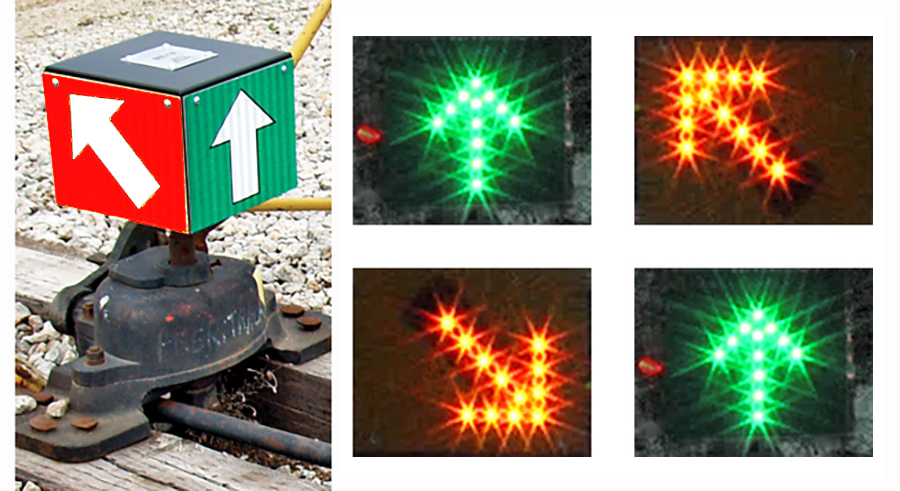
Normally, railyards use standard placards to indicate which way a track switch is thrown. While this system works during the daytime, it can create serious safety concerns at night. If an incoming crew can’t easily read the switch direction, they could send a railcar down the wrong track and directly into a loading operation. To solve this problem, Northern Platforms supplies Aldon switch cubes.
Switch cubes are illuminated and reflective indicators that clearly show which direction a switch is thrown, regardless of visibility conditions. This product comes in a variety of configurations and options and is particularly useful for facilities with multiple tracks and loading positions.
Northern Platforms is Your Source for Railcar Safety Equipment
For most railyards, blue flags are just the beginning. In order to create a safe working environment for all operators, these sites often need wheel chocks, loading platforms, spill containment solutions, and more. That’s where Northern Platforms comes in.
At Northern Platforms, we supply a variety of Aldon railyard safety products for Western Canadian industrial operations. Our catalogue includes blue flag signs, blue lights and solar lighting systems, derails and derail accessories, wheel chocks, switch cube indicators, tank car sockets, and more.
Additionally, we are a turnkey provider for high-quality railcar loading systems, including complete system design and installation of railcar loading arms and fall protection.
Contact Us for a Railcar Safety Equipment Quote Today
At Northern Platforms, we have nearly 30 years of experience improving the safety and efficiency of industrial operations in Western Canada. We proudly serve businesses in a variety of industries, including oil and gas, agriculture, food and beverage, and more. Interested in partnering with us on your next project or facility upgrade? Explore our products, request a quote through our website, or call our sales teams today. We can’t wait to work with you.