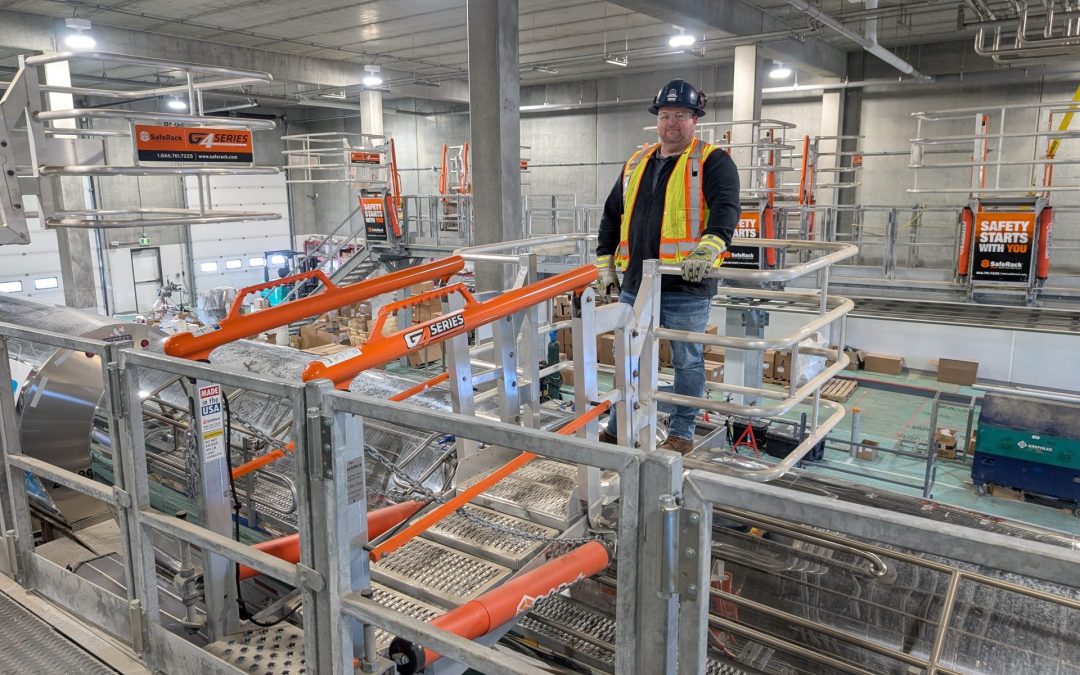
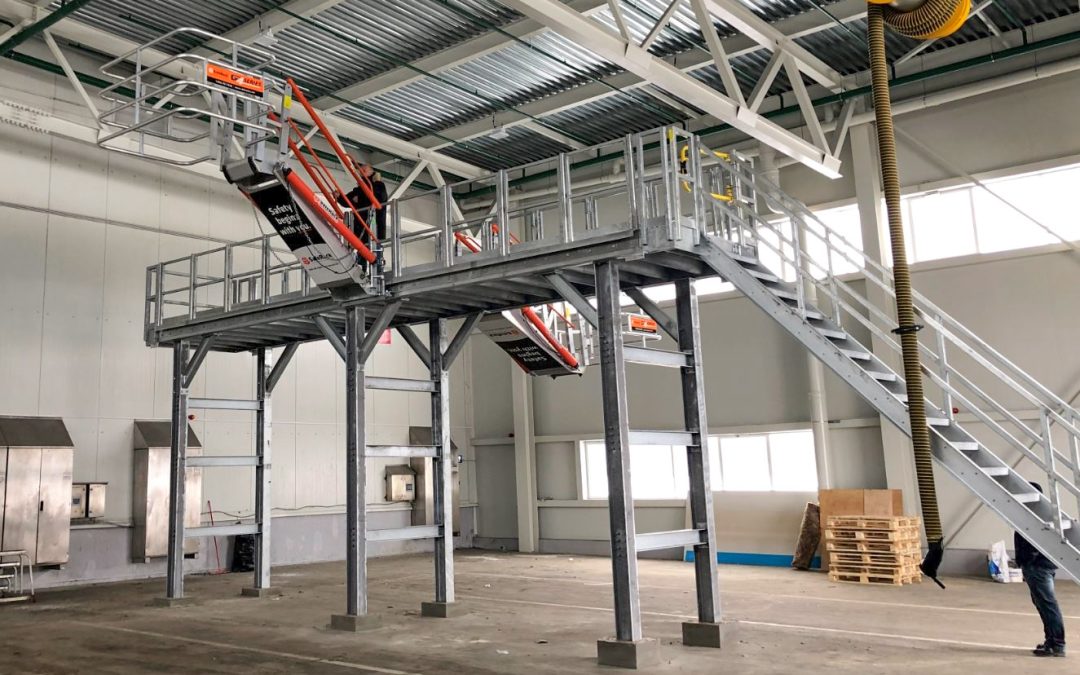
Articulating stairs, or self-adjusting gangways, bridge loading platforms to tanker trucks and railcars. These systems are essential for operations around Alberta and BC, especially when handling mixed fleets or frequent vehicle mis-spotting. However, selecting the right system isn’t simply about choosing between SAS, SFR, and FRT configurations. A successful installation requires careful measurement, specification validation, and alignment with your site’s operational realities. This buyer’s guide walks you through the process of selecting a gangway, from initial site assessment through final specifications. Keep reading to learn more!
How to Choose the Right Articulating Stairs: Step-by-Step
Many existing operations would benefit from adding articulating stairs to their site. However, choosing the right model can be tough–especially if you don’t know what to watch out for. Let’s walk through it, step by step.
Step 1: Take Accurate Measurements
Accurate measurements are the foundation of your system. Before you start shopping, make sure you have these details on hand:
Lowest hatch height
Highest hatch height
Horizontal reach (especially if you experience frequent mis-spotting)
Size limitations of existing platforms
Step 2: Assess Your Operations
Your site’s daily realities also play a crucial role in finding the right system. We recommend documenting the vehicles that consistently use your loading bay:
Truck types: Box trucks, tankers, hoppers—each trailer type has different hatch heights and loading profiles.
Railcar types: Covered hoppers (which need FRT-style telescoping access), liquid tankers, and flat cars also need different accommodations.
Height consistency: Do all vehicles in a category arrive at roughly the same height, or is there significant variation between loads?
If heights are consistent, a Simple Flat Ramp (SFR) is cost-effective and low-maintenance. If heights vary by load, load condition, or suspension state, a Self-Adjusting Stair (SAS) with self-levelling is worth the investment.
Additionally, you should track how often vehicles park off-center or at the wrong hatch locations. Monitor frequency, re-spotting time, and any associated safety risks. If mis-spotting is rare and re-spotting is quick, opt for a stationary gangway. If it’s frequent (more than once per shift), a track-mounted gangway can help significantly increase the efficiency of your site.
Step 3: Decide on Key Features & Specifications
Now that you have a clear sense of your site’s size and needs, you can finalize additional features of your articulating stair system, including:
Gangway width and load ratings
Safety cage design
Power and control systems
Materials
Compatibility with existing systems, including loading arms.
Questions to Ask Before Buying
In order to find the ideal system for your site, ask yourself these questions:
What is the height range of vehicles at your loading bays? Do these heights vary? Measure from the platform deck to typical hatch heights for both trucks and railcars. Include minimum and maximum heights to ensure adequate adjustment range.
How frequently do vehicles mis-spot? If re-positioning happens more often than not, track-mounted or FRT configurations will save significant time and frustration.
What are your platform space constraints? Existing platforms may limit gangway width, cage depth, or track length. Northern Platforms can engineer solutions to fit tight spaces.
Do you need multiple gangways? High-volume facilities may require multiple articulating stair systems. Northern Platforms can design coordinated installations for maximum efficiency.
How to Choose the Right Articulating Stairs
Once you’ve answered all the questions above, you should have a clear understanding of your top priorities. Use these insights to make an informed decision about your articulating stairs. Still not sure which option is right for you? Use this table to help make your decision:
Your Situation
Recommended System
Why It Works
Mixed truck heights, frequent vehicle changes
SAS (Self-Adjusting Stairs)
Self-levels to any height; stairs provide a solid foundation
Liquid railcar loading with mis-spotting issues
FRT (Flat Ramp Telescoping)
Can reach offset hatches; eliminates re-spots
Hopper cars or trucks with consistent heights
SFR (Simple Flat Ramp)
Simple, stable, low-maintenance solution for predictable applications
Multiple vehicle types and unpredictable positioning
SAS with track mounting
Combines height adjustment with a flexible track
LPG, asphalt, or chemical loading requiring quick access
SAS with power assist
Fast deployment and retraction; reduces manual handling
Why Choose Northern Platforms
Northern Platforms is Western Canada’s leading supplier of safe access solutions, including SafeRack articulating stairs and gangway systems. We offer:
Expert site assessment: Our team conducts thorough measurements and site evaluations, ensuring specifications match your operational realities.
Turnkey installation: From design through final safety testing, we handle the complete build and integration process.
Preventive maintenance and support: Our maintenance contracts minimize downtime and extend system lifespan, critical for high-cycle operations and harsh Western Canadian conditions.
Local presence: Based in Alberta, we can be on your site within hours.
Contact Us Today!
Ready to get started? Northern Platforms is here to help. Call our office or request a quote through our website now.
An essential part of many Albertan industries, tanker trucks transport essential chemicals, food products, and water on a daily basis. However, without proper fall protection, these essential trailers can become dangerous work sites. In this blog post, we’ll discuss the basics of a truck loading platform—including how they are used, what industries rely on them, and the elements that make up the ideal system. Keep reading to learn more!
What is a Truck Loading Platform?
A truck loading platform is a specialized access system designed to provide safe, elevated access to the tops of tanker trucks and trailers during loading and unloading operations. These platforms typically consist of a sturdy steel or aluminum structure with integrated stairs, handrails, and safety features that allow workers to safely reach truck hatches, connection points, and inspection areas. By utilizing these systems, workers are protected from the significant safety risks of vehicle-mounted ladders.
Common Industrial Uses for Truck Loading Platforms
In today’s industrial world, tanker trucks are used to transport a wide variety of items. Here are some common industries that use tanker truck loading platforms daily.
Chemicals and Refined Fuels
As Alberta’s leading sector, oil and gas facilities rely on loading platforms to safely load and unload the hazardous materials they deal with on a daily basis.
Uses: In addition to basic access, operators will use a truck loading rack to connect loading arms, vent overfills, and monitor transfer operations.
Special Considerations: When dealing with harsh chemicals, pay close attention to the materials of your loading system. Opt for a strong and corrosion-resistant material like stainless steel.
Food and Beverage Operations
Food and beverage facilities across Canada require truck loading platforms that meet the highest sanitary standards while maintaining worker safety during liquid ingredient transfers.
Uses: Typically, workers in the food and beverage industry use loading platforms to inspect hatch seals for contamination prevention, connect food-grade hoses and loading arms, collect quality control samples, and monitor transfer operations of milk, juices, cooking oils, and liquid sweeteners.
Special Considerations: Food-grade materials and seals are a must for food and beverage operations. Northern Platforms has extensive experience building systems that meet or exceed the stringent sanitary regulations in this industry.
Bulk Water Stations
Remote locations and Northern communities depend on water filling trucks to access clean drinking water. However, without adequate fall protection, operators face a large risk of catastrophic injury.
Uses: Operators use these platforms to safely access the tops of water tanker trucks and provide potable water to local residents.
Special Considerations: Many Northern Canadian communities rely on truck fill stations. However, these areas also deal with harsh temperatures which demand systems that function up to -40°C. With over two decades of experience working with cold temperatures, Northern Platforms regularly builds systems that are built for the climate.
A platform to provide a solid foundation and stable work surface for workers.
Gangways are used to connect the main platform to the vehicle and protect operators from falling. Northern Platforms stocks three different gangway options which are suitable for a variety of applications. We recommend adding a safety cage to end of your gangway for complete protection.
Finally, pair your platform with a loading arm for smooth loading and unloading operations. These systems are sturdier and safer than hoses and can significantly increase the efficiency of your operation.
How Northern Platforms Can Help
With over 20 years of experience designing, building, and installing custom truck loading platforms, Northern Platforms is your trusted partner for all things fall protection. We have experience building tanker truck loading platforms for a variety of industries, including oil and gas operations, food and beverage facilities, municipal water filling stations, and more. Here’s how our process works:
On-site Consultation: Our convenient Central Alberta location means that we can be on your site within a couple of hours. Once we arrive, we’ll conduct a thorough evaluation to understand your operational requirements, safety challenges, and more.
Truck Loading Platform Design: Next, we’ll draw on decades of collective experience to design a tanker truck loading system that integrates seamlessly into your site. Our designs consider everything from material compatibility to local safety regulations. We’ll also provide a cost estimate at this stage.
Turnkey Installation: Avoid the headache of working with multiple contractors—Northern Platforms can take care of it all. With our turnkey installation services, we’ll ensure that your platform, gangway, and loading arm work together.
Request a Quote Today!
Ready to upgrade your truck loading platform? Call Northern Platforms today! Let’s work together to make your site safer and more efficient.
With the warmer temperatures comes the busy season for cement, asphalt, concrete, and fly ash operations. The last thing your business needs during peak season is a job site accident or injury to derail or stop production. Fortunately, with the proper safe access solutions, such as truck access platforms and safety cages, you can reduce the chances of an accident and ensure productivity. This is where Northern Platforms, with our comprehensive inventory of SafeRack products, can help! Let us explain further below…
Challenges in Cement Loading and Unloading
When loading and unloading cement trucks, there are several unique challenges and risks, especially regarding fall protection and truck access. In particular, high cycle rates, oversized and multi-truck configurations, multiple hatches, and nonstandard hatch opening orientations are a few factors that impact your operation’s efficiency and workers’ safety.
Since cement operations typically involve loading/unloading materials from a height, there is also a significant fall risk. One way to ensure the safety of your employees is to utilize a truck access platform or gangway, as well as a safety cage from Northern Platforms. Our offering of SafeRack gangways and cages provides a safe, enclosed walkway for your personnel to use when navigating between different levels, while the safety cage prevents them from slipping or falling off the edge. That way, not only are you improving the safety of your operations but also enhancing efficiency as your staff does not have to worry about working in potentially unsafe conditions.
At Northern Platforms, we recommend two critical safe access solutions for our customers in the cement industry–the SafeRack G4 Series Offset Cage and SAS Gangway. Let’s explore these truck access platform components below:
G4 Series Offset Cage
This innovative and durable safety cage was explicitly designed for the cement industry. The G4 Series Offset Cage features flared and tapered rungs, enabling the lid to have a full range of motion even while the equipment is in a working position. At the same time, the design of this safety cage ensures that it and the truck access platform it’s connected to will not have any interference when lowered on top of your cement trucks.
Like all SafeRack products, the G4 Series Offset Cage is manufactured with safety and longevity in mind. It is made with heavy-duty aluminum, advanced manufacturing techniques, and robotic welding to ensure its capabilities in demanding high-cycle applications. With the G4’s versatility to be a left or right offset, this is the perfect safety cage for any cement, asphalt, or dry ash operations.
SAS Gangway
When you need an easy-to-use and extremely rugged truck access platform, the SAS Gangway should be your first choice. Built to articulate and self-level, it can easily accommodate a variety of truck heights, with a working range of 40° below and 45° above horizontal. With extra-strong tube designs for safety cage mounting, a one-piece stair design, and reduced weld points, this truck access platform is built to last even in the most challenging applications.
Available at Northern Platforms in 24″, 36″, 48″, 60″, and 72″ widths and numerous lengths, the SafeRack SAS gangway is an excellent truck access platform option for operations handling cement, asphalt, or trucks of varying sizes.
Ready to Invest in Safety?
Northern Platforms can help you make your worksite safer by retrofitting your cement truck loading system with the SAS gangway or outfitting your operations with both the SAS platform and G4 Series safety cage. With our team’s help and our turnkey services, Northern Platforms can ensure that your operations are safe and efficient, no matter the material or vehicles you’re loading/unloading.
















![The Complete Buyer’s Guide to Articulating Stairs [2025]](https://northernplatformsltd.ca/wp-content/uploads/2025/05/self-adjusting-stairs-and-gangway-canada.jpg)